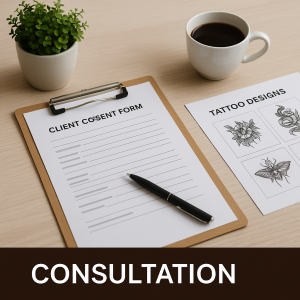
A good consultation turns a broad idea into a clear brief. The aim is to understand what the client wants, explain what you can offer and make sure neither person is relying on assumptions. You can practise these conversations before working with clients.
Start with the result, not a sales pitch
Ask what the person likes about their reference: the subject, placement, size, colour or overall feeling. Two people can point to the same image for completely different reasons. Follow up with an open question such as, “What would you most want to keep about this idea?”
Then summarise the answer in plain language: “You want a small botanical design, mainly fine lines, with enough space around it to read clearly.” Invite corrections before moving on. A short summary often reveals a misunderstanding sooner than another ten minutes of discussion.
Separate preferences from promises
Explain the proposed design and process without guaranteeing an exact copy of a reference photograph or a particular result. Say when a question needs your trainer’s input or a separate professional assessment. An honest boundary is more useful than an answer invented to keep the conversation moving.
Discuss the agreed service, what the quoted price includes and what would count as a change to the brief. If a decision is still open, write it down as open. Do not let an informal message become an accidental promise about a service you have not agreed to provide.
Use a short written recap
- The proposed design or service and intended placement.
- The reference points agreed, and any changes still to be decided.
- The quoted scope and the next step.
- Any questions that need an answer before proceeding.
Keep this recap separate from permission to publish photographs. Use the studio’s appropriate consultation and consent process; a friendly chat is not a replacement for its records.
Handle uncertainty without pressure
If someone hesitates, ask what is unclear. They may be unsure about the design, the commitment or the explanation. Give them space to decide. Avoid treating every concern as an objection to overcome. “We can pause while you think about the placement” is clearer than repeatedly telling someone not to worry.
Practise a five-minute consultation
Ask a friend to play a client with a reference image and an unclear idea. Spend two minutes asking questions, one minute summarising, and two minutes explaining the next step. Afterwards, ask them to repeat what they understood. If their version differs from yours, change the explanation rather than simply saying it louder.
For tutor feedback, submit an anonymised practice brief with your questions and recap. Leave out private client details. This gives your tutor something specific to review and helps you improve one communication habit at a time.
A fictional enquiry, not a confirmed booking
Suppose someone asks for a small botanical tattoo but has not chosen its placement. A useful reply is: “You are interested in a botanical design. Placement and final size still need discussion, so this is an enquiry rather than a confirmed appointment. The next step is to send your preferred placement and arrange a consultation.” Ask your practice partner to identify what is agreed, what is open and what they should do next. This tests whether your explanation is clear, without inventing a quote or collecting private client details.
Continue your study in Canada
For structured study, explore the online tattoo course or online piercing course for learners in Canada. Review the course outline and current options before choosing your training.
Ask the Skinart team about your learning plan if you need help matching a course to the skills you want to practise.