Piercing School vs Online Piercing Course
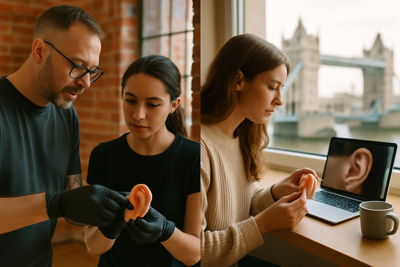
Choosing between a traditional piercing school and an online piercing course is one of the biggest decisions you’ll make when starting a career in body piercing. In this article we compare Piercing School vs Online Piercing Course in the United Kingdom, helping you understand the practical, legal and career implications so you can make an informed choice.
As the demand for accredited training rises across the UK, prospective piercers need clear guidance on learning pathways, accreditation, and what employers expect. This comparison will explore learning outcomes, hands-on practice, assessment, costs, and how an online option can still meet UK industry standards.
Gary teaches Skinart’s tattoo, piercing and body art courses. Review the course curriculum and lesson examples to understand the training offered.
Table of Contents
Use these links to jump to the section you need — search engines can use them to generate “Jump to” links in results.
- What “Piercing School vs Online Piercing Course” Really Means
- Piercing School vs Online Piercing Course — Head-to-Head
- What You Learn: Curriculum and Skills
- Common Mistakes New Piercers Make
- Assessment, Accreditation & UK Regulations
- Costs, Time & Practical Considerations
- Success Stories from the United Kingdom
- Frequently Asked Questions
- Final Thoughts & Next Steps
What “Piercing School vs Online Piercing Course” Really Means
When we talk about Piercing School vs Online Piercing Course we’re comparing two distinct learning pathways. A traditional piercing school typically offers face-to-face classroom time, supervised practical sessions and immediate hands-on mentoring. An online piercing course delivers theoretical content through videos, readings and remote assessments, often combined with virtual feedback or limited practical workshops.
In the United Kingdom, the critical variables are accreditation, safe practice, legal compliance, and the ability to demonstrate competence to local councils or employers. Both pathways can lead to a recognised qualification, but the route you choose affects how you gain practical experience, how quickly you start taking clients, and how employers perceive your readiness.
At Skinart United Kingdom we provide an accredited online piercing course designed to mirror the learning outcomes of in-person training while emphasising safety, infection control and professional aftercare. This article will outline the trade-offs so you can decide which option aligns best with your lifestyle and career goals.
Piercing School vs Online Piercing Course — Head-to-Head
Below we present a concise comparison so you can weigh up pros and cons quickly before reading the deeper sections that follow.
- Hands-on practice: Piercing school typically offers immediate supervised practice; online courses rely on simulated modules and remote assessments or partner clinics.
- Flexibility: Online courses let you learn at your own pace from anywhere in the UK, which is ideal for students balancing work or family commitments.
- Cost: Online courses are often more affordable because they remove facility and staffing overheads.
- Assessment style: In-person schools may use direct observation; accredited online courses use video submissions, quizzes and remote viva assessments.
- Local compliance: Both must align with UK health regulations and local council requirements; documentary evidence of competence is usually required for licensing.
Pros and cons vary depending on the individual. If you need a rigid schedule and immediate mentorship, in-person options may suit you. If you require flexibility and still want accreditation recognised across the UK, a well-structured online piercing course can meet your needs.
Skinart United Kingdom’s online piercing course has been designed with these trade-offs in mind: robust practical assessment pathways, clear accreditation, and ongoing tutor support so students can demonstrate competence without attending physical classes.
What You Learn: Curriculum and Skills
Whether you train in a piercing school or complete an online piercing course, the curriculum should cover core competencies that protect clients and practitioners. The key components are anatomy, infection control, sterilisation, safe piercing techniques, aftercare advice and legal responsibilities in the UK.
At Skinart United Kingdom our online piercing course maps to CPD Standards Office and BAQA outcomes. This means you’ll be taught the theory behind safe practice, how to identify contra-indications, and the precise steps involved in different piercing types — all with UK-specific regulatory context and client communication strategies.
Practical technique is emphasised through detailed video demonstrations, step-by-step procedure breakdowns, assessment rubrics and structured video submissions. To illustrate the breadth of learning, here’s a typical module list you can expect:
- Introduction to professional piercing practice and ethics
- Human anatomy relevant to common piercing sites (ears, nose, navel, nipples)
- Infection prevention, cross-contamination and sterilisation methods
- Local anaesthesia considerations and pain management strategies
- Piercing techniques, instrument handling and fitting jewellery correctly
- Aftercare protocols and client education for UK climates and lifestyles
- Record-keeping, consent forms and client history in compliance with UK data protection
- How to manage complications, recognise infections, and when to refer clients
- Business setup basics, insurance considerations and professional development
Common Mistakes New Piercers Make
- Skipping thorough anatomy study and misjudging placement
- Insufficient practice on realistic models before live clients
- Poor record-keeping and incomplete consent documentation
- Inconsistent sterilisation practices or misunderstanding autoclave validation
- Rushing procedures — haste increases complication risk
- Using inappropriate jewellery materials for sensitive clients
- Not recognising early signs of infection or allergic reactions
- Poor aftercare communication, leaving clients unprepared for realistic healing times
These mistakes can occur whether a student trains in-person or online. The difference lies in how the learning experience addresses them: practical mentorship helps reduce early technical errors, while a rigorous online course will require evidence of competence through assessed video work and detailed tutor feedback.
For students in the UK, understanding local council expectations and national guidance on infection control is essential to avoid regulatory issues when you begin practicing professionally.
Assessment, Accreditation & UK Regulations
Accreditation is non-negotiable in the UK. Whether you choose a piercing school or an online piercing course, ensure the provider is recognised by the CPD Standards Office and the Body Art Qualification Association (BAQA). Skinart United Kingdom’s online piercing course is fully accredited by both organisations and aligns with UK public health expectations.
Assessment methods can include written assignments, multiple-choice quizzes, video submissions of practical work, and a final practical assessment observed remotely or in a partner clinic setting. We use a combination of evidence-based assessment tools so that outcomes are comparable to those from face-to-face schools.
- Verified written assessments on theory and legal responsibilities
- Video-based practical submissions assessed against detailed rubrics
- Reflection logs and client case studies to demonstrate decision-making
- Final competence sign-off aligned with BAQA criteria
- Guidance on presenting evidence to local councils for licensing
- Access to tutor feedback and corrective action plans where needed
- Document templates for consent, medical history and incident records
- Support with CPD record-keeping and continuing professional development routes
Local councils often require documentary proof of competence — not necessarily physical attendance at a school. High-quality, accredited online courses that provide assessed practical evidence are increasingly accepted by licensing bodies across the UK.
Costs, Time & Practical Considerations
Budget, time availability and access to practical mentoring are often the deciding factors when choosing between piercing school and an online piercing course. In-person training can be more expensive when factoring in travel, accommodation and facility fees. Online courses generally reduce overheads and can be completed around other commitments.
One common misconception is that online automatically means less rigorous. A properly accredited online piercing course will be structured with clear milestones, practical evidence requirements and tutor-led remediation where necessary — it simply delivers learning differently.
Important practical notes for students in the UK:
- We do not supply piercing equipment in the United Kingdom — students must make their own arrangements to obtain approved instruments and jewellery.
- Plan a budget that includes insurance, initial jewellery stock and any local licensing fees.
- Check your local council’s requirements for body art operators before you begin practising.
- Factor in time for practical assessment — online courses often require recorded submissions that can take multiple attempts to perfect.
- Consider travel time for any optional in-person assessments or partner clinic observations.
- Allow time for building a client base and developing a professional portfolio.
- Account for CPD and refreshers — UK regulations and best practice evolve, and ongoing training is essential.
- Estimate additional costs for hepatic or BBP (blood-borne pathogen) modules if your insurance requires them.
Local Examples & Success Stories from the United Kingdom
Real-world examples help bring the comparison to life. In Manchester, a recent Skinart United Kingdom graduate completed our accredited online piercing course and submitted a portfolio of practical video assessments. The local council accepted the documentation for registration and the graduate now operates at a reputable barber and studio collaboration.
Another graduate in Edinburgh used the course’s business and portfolio modules to secure a position assisting at a busy body art studio. Their employer noted that the graduate’s understanding of aftercare and infection control exceeded expectations — demonstrating that a well-structured online course can prepare students very effectively.
These success stories illustrate that when an online course has rigorous assessment standards and accredited documentation, students across the UK can meet licensing requirements and find paid opportunities quickly.
Frequently Asked Questions — Piercing School vs Online Piercing Course
Below are concise answers to common questions prospective students ask when deciding between pathways.
Can an online piercing course be accepted by UK local councils?
Yes — provided the course is accredited (for example by the CPD Standards Office and BAQA), includes assessed practical evidence and supplies verifiable documentation of competence. Skinart United Kingdom’s online piercing course is designed with these requirements in mind.
Which is better for beginners: piercing school or an online piercing course?
Beginners who need structured, flexible learning often do well with a high-quality online course that requires practical evidence. Those who prefer immediate hands-on mentorship may prefer an in-person school — but top online courses bridge this gap with video-based assessments and detailed tutor feedback.
Do employers in the UK accept online training?
Many employers accept online training when it is accredited and includes practical competence evidence. Employers prioritise demonstrable skill, safe practice and reliable documentation more than the training format itself.
Will I receive support from tutors during an online course?
Yes. Accredited online courses, including Skinart’s, provide tutor feedback on assessments, support with improving techniques and guidance on preparing documentation for local licensing.
Is practical equipment supplied with the course?
No — Skinart United Kingdom does not supply piercing equipment for students in the UK. Students should source approved equipment and jewellery themselves as part of their preparation.
FAQ answers above are intentionally concise. If you have a specific council or employer in mind, check their exact documentation requirements — we can help you prepare the right evidence packages.
Final Thoughts — Which Path Should You Choose?
Deciding between Piercing School vs Online Piercing Course comes down to your learning style, time commitments and career goals. If you need flexible study that fits around other responsibilities, an accredited online course such as Skinart United Kingdom’s option can deliver industry-recognised outcomes, rigorous practical assessment and tailored tutor support.
If you prefer immediate hands-on mentorship and thrive in a classroom setting, look for a local school with supervised practice. Bear in mind, however, that we do not offer in-person piercing training in the United Kingdom — our focus is on providing an accredited, practical online pathway that satisfies UK regulatory expectations.
Whichever route you choose, prioritise accredited providers, clear assessment protocols and learning outcomes that emphasise safety and client care. When you’re ready to begin, Skinart United Kingdom’s online piercing course offers a structured, accredited pathway designed specifically for students who intend to practise across the UK.
Ready to Get Started?
Begin an accredited, tutor-led online piercing course designed for the United Kingdom. Gain CPD and BAQA-aligned outcomes and the evidence you need to practise safely.
Recent Blog Posts
 Avoid These Consultation Mistakes in 2026A good consultation leaves the client and artist with the same understanding of the proposed work, its limits and the next…
 Sterilization 2026: Setting the Gold Standard in Your StudioReviewing a studio's sterilization arrangements means checking an established, documented process with a qualified person. A clean-looking instrument or a completed…
 Time Management for Creative Body Artists: 2026A useful studio schedule includes more than appointment time. Design work, client conversations, preparation, cleaning, records and learning all need space.…