Online Tattoo Removal Course: What You’ll Learn
Welcome — if you’re researching an Online Tattoo Removal Course in the United Kingdom, you’re in the right place. This article walks you through exactly what you’ll learn on a professional, accredited online tattoo removal programme from Skinart United Kingdom. By the end you’ll understand the theory, practical method, safety standards and career pathways our course opens for you.
The Tattoo Removal Method Taught in This Course
This course specifically teaches the saline syrem rejection method. This is a non-laser method that uses a specially formulated rejection syrem, which is tattooed into the skin over the unwanted pigment. It is more complex than simply tattooing saline. The course explains the ingredients, the full recipe, preparation and correct application, so you can learn how to mix your own syrem for use during the procedure.
The training also covers application, hygiene, safety and aftercare. Local licensing and health requirements still apply.
Skinart United Kingdom specialises in evidence-based body art education. Our Online Tattoo Removal Course teaches the ink-rejection removal method — a medically informed technique that inks a removal solution into the dermis to draw pigment out safely, minimise sessions and reduce scarring compared to many laser approaches.
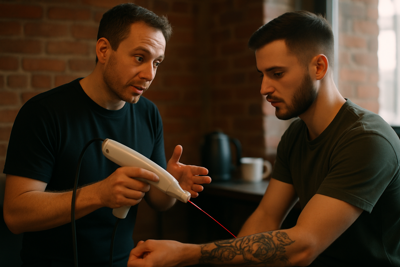
Gary teaches Skinart’s tattoo, piercing and body art courses. Review the course curriculum and lesson examples to understand the training offered.
Table of Contents
Use the links below to jump to any section — we use semantic anchors so search engines may show “Jump to” links in results.
Tip: press Ctrl/Cmd + F to search this page for specific topics such as “aftercare” or “assessment”.
Sections
- Introduction: What the course covers
- Pros and Cons of the Ink-Rejection Method
- Course Curriculum — Module by Module
- Common Mistakes to Avoid
- Aftercare & Client Communication
- Assessment, Certification & Accreditation
- UK Considerations: Law, Insurance & Examples
- FAQs: What learners ask
- Final Thoughts & Next Steps
Introduction: What the course covers
The Online Tattoo Removal Course from Skinart United Kingdom is built for technicians, tattoo artists and aesthetic practitioners who want to add a safe, effective removal option to their services. Our program breaks down the ink-rejection removal method into clear, evidence-led modules that you can complete at your own pace. The course emphasises anatomy, hygiene, client assessment, practical application of the removal solution and safe aftercare.
Unlike laser techniques, the ink-rejection method taught on this course involves delivering a formulated removal solution into the dermis to bind and lift pigment particles. The curriculum covers how this process works biologically, why it can reduce the total number of sessions, and how to adapt technique for different ink colours and skin types.
Every lesson is aligned to CPD Standards Office benchmarks and our assessments meet the Body Art Qualification Association criteria. We clearly explain scope of practice, including what we teach and what we do not: in the United Kingdom we do not supply tattoo removal equipment; our training prepares you to select suitable suppliers and operate within local legal frameworks.
Pros and Cons of the Ink-Rejection Method
Before enrolling in an Online Tattoo Removal Course, it helps to weigh the advantages and limitations of what you’ll learn. Our course presents the ink-rejection method honestly so you can make informed, ethical choices for your clients’ care.
- Pros
- Effective on a broad range of colours, including stubborn blues and greens.
- Often requires fewer sessions than some laser protocols.
- Lower risk of hypopigmentation when performed correctly.
- Cost-effective for both practitioner and client in many cases.
- Cons
- Requires detailed training and strict adherence to hygiene standards.
- Some skin types may respond less favourably; assessment is critical.
- We do not supply equipment in the United Kingdom — practitioners must source approved products.
- Clients should be counselled that complete removal is not guaranteed for every tattoo.
The Online Tattoo Removal Course teaches how to manage those cons: how to perform accurate client assessments, set realistic expectations, document informed consent and design a treatment plan specific to each tattoo and client.
We also place strong emphasis on record-keeping and legal compliance in the UK context, so you leave the course ready to operate professionally and confidently.
Course Curriculum — Module by Module
Our Online Tattoo Removal Course is structured so each module builds on the last. You’ll start with foundational theory, advance to practical technique demonstrations, and finish with assessment and business integration guidance. Below is a representative breakdown of the main modules you’ll complete.
The course is delivered through high-quality video lessons, downloadable resources, case studies and assessment tasks. Because we focus on competence, each module includes knowledge checks and practical assignments you submit for tutor feedback.
Modules are designed specifically for UK practice, addressing local regulatory expectations, infection control standards and how to safely advise clients with relevant medical histories.
- Module 1: Skin anatomy and wound healing — understanding dermal layers, pigment behaviour and healing timelines.
- Module 2: Pigment science — why different inks respond differently and how to predict outcomes.
- Module 3: The ink-rejection removal solution — formulation principles, contraindications and safe handling.
- Module 4: Infection prevention and BBP protocols — practical hygiene for the UK clinic environment.
- Module 5: Client consultation and consent — medical history, patch testing and expectation management.
- Module 6: Practical technique — step-by-step demonstrations, needle selection, depth control and pressure.
- Module 7: Aftercare planning — dressing, topical care and managing common reactions.
- Module 8: Special considerations — darker skin types, scarred tattoos and cover-up preparation.
- Module 9: Business and legal essentials — insurance, pricing, record keeping and local health rules.
- Module 10: Assessment and case submission — practical evidence, theory test and tutor sign-off.
- Module 11: Client pathways and referral — when to recommend dermatology or specialist input.
- Module 12: Ethics and communication — handling complaints and building client trust.
Common Mistakes Practitioners Make
- Insufficient client assessment — failing to identify medications or health conditions that affect healing.
- Poor documentation — not keeping detailed records of solutions used, patch tests or consent forms.
- Overzealous depth control — placing solution too deep leads to scarring or prolonged healing.
- Underestimating pigment complexity — assuming all colours will react the same way.
- Inadequate aftercare instructions — clients who don’t follow aftercare risk infection or poor outcomes.
- Using unverified products — buying cheap or uncertified solutions compromises safety.
- Rushing treatments — skipping test patches or progressing too quickly between sessions.
- Poor client communication — unrealistic promises or not explaining likely outcomes clearly.
- Neglecting cross-infection procedures — failing to follow BBP protocols during and after treatment.
- Not having clear referral pathways — not knowing when to send a client to dermatology or another specialist.
Our course explicitly addresses each of these errors. For every common mistake we provide clear mitigations: checklists for assessment, downloadable consent templates, stepwise technique videos and case-based learning so you can see how experienced clinicians handle complications.
We also give guidance on sourcing reputable suppliers within the UK and how to evaluate product datasheets and safety information. This keeps your practice compliant and your clients protected.
Aftercare & Client Communication
Good aftercare is as important as the technique used during the treatment. The Online Tattoo Removal Course places strong emphasis on evidence-based aftercare protocols that speed healing, reduce infection risk and support optimal pigment rejection.
You’ll learn how to create client-specific aftercare plans, including step-by-step wound care, when to expect mild reactions, how to spot signs of infection and clear instructions on activity limitations (swimming, sun exposure, gym sessions) during healing.
Communication templates are included so you can provide printed or digital aftercare that matches current best practice. Clear communication reduces complication rates and increases client satisfaction — a crucial part of building a successful UK practice.
- Immediate wound care checklist (first 24–72 hours)
- Cleaning and dressing schedule
- Topical products to avoid and why
- Signs of infection and when to seek help
- Follow-up appointment timing and what to check
- Guidance for sun exposure and pigment migration
- How to support clients with previous scarring or keloid tendency
- Documentation for client files and consent records
Assessment, Certification & Accreditation
Assessment is competency-based. You will complete online theory tests, submit case studies and practical evidence (photographs and written reflective logs) and receive tutor feedback from Skinart’s accredited trainers. The course meets CPD Standards Office requirements and is recognised by BAQA, giving you credible certification on completion.
Our assessments focus on safety, decision-making and the ability to plan and execute removal treatments for a range of common tattoo presentations. We test your understanding of anatomy, infection control, solution handling and aftercare planning.
After successful completion you receive an accredited certificate that demonstrates your competence in the ink-rejection tattoo removal method. This certificate supports your professional profile when applying for insurance or listing services on your website.
“The CPD Standards Office recognises structured, evidence-based programmes as essential for safe practice. Proper training, assessment and record-keeping reduce client risk.” — CPD Standards Office guidance summary
UK Considerations: Law, Insurance & Real Examples
Operating in the United Kingdom carries specific obligations. Practitioners must ensure compliance with local environmental health requirements, hold suitable public liability and professional indemnity insurance, and be familiar with any local licensing rules. Our course includes a dedicated UK guidance pack that helps you identify the right insurance products and documents you’ll need to demonstrate safe practice.
We also include short case studies from UK-based alumni to help contextualise the training. For example: a recent student in Manchester successfully added ink-rejection removal to their studio’s services, closing 30% more consults by offering a lower-scarring option and clear aftercare. Another graduate in Bristol used the course to formalise consent procedures, which improved client trust and online reviews.
Where relevant, we direct learners to authoritative bodies such as the CPD Standards Office for accreditation context and the British Association of Dermatologists for clinical background on skin types and wound healing. These references help you make safe, evidence-informed choices for practice.
Frequently Asked Questions
What will I learn on an Online Tattoo Removal Course?
You will learn skin anatomy, pigment science, the ink-rejection removal technique, infection control, client assessment, aftercare, business and legal responsibilities and how to document and submit cases for assessment.
Is the course accredited in the United Kingdom?
Yes. Skinart United Kingdom’s Online Tattoo Removal Course is aligned with the CPD Standards Office and recognised by the Body Art Qualification Association (BAQA), and the certificate provided on completion is suitable for most insurers and professional listings.
Do you provide equipment for the ink-rejection method in the UK?
No. We do not supply tattoo removal equipment in the United Kingdom. The course teaches technique, product selection criteria and safety protocols so you can confidently source approved supplies from reputable UK vendors.
How is practical assessment handled online?
Practical assessment requires you to submit clinical case evidence, photographs and reflective logs. Tutors review submissions and provide feedback; you must demonstrate safe practice and correct technique to gain sign-off.
Will this course teach laser tattoo removal?
No. This Online Tattoo Removal Course focuses exclusively on the ink-rejection removal method. We discuss laser approaches for context but do not provide laser training.
Final Thoughts: Ready to add tattoo removal to your services?
Completing an accredited Online Tattoo Removal Course is a practical step toward expanding your professional offering. The ink-rejection method we teach offers a reliable alternative to laser for many clients, and the skills you gain will increase client retention and referral opportunities in your local UK market.
At Skinart United Kingdom we back every learner with tutor support from industry-experienced trainers. Gary Erskine and the Skinart team provide detailed feedback on case submissions so you leave the course confident and capable of delivering safe, effective treatments.
If you’re ready to learn, practise under expert guidance and add a high-value service to your business, this course is built to get you there.