Piercing School vs Online Piercing Course
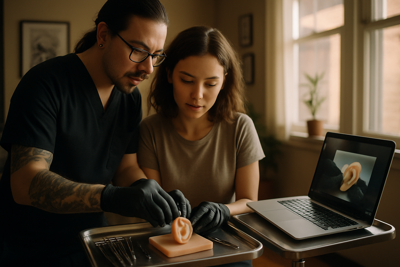
Choosing between a traditional piercing school and an online piercing course is one of the most important decisions for anyone starting a career in body piercing in the United States. In this article we compare Piercing School vs Online Piercing Course in practical terms so you can make an informed, safe and legally compliant choice. Whether you plan to work in a bustling studio in New York City, a boutique in Austin, or launch a mobile service in Los Angeles, the right training pathway matters.
Throughout this guide we’ll explain the practical realities—what skills you’ll gain, how accreditation and health and safety work in the US context, costs, timelines and the real-world outcomes students experience after completing an online piercing course versus an in-person school. Expect clear comparisons and actionable next steps so you can move confidently toward professional accreditation.
Table of Contents
Choose a section to find the information you need.
- What is the difference between Piercing School vs Online Piercing Course?
- Pros & Cons of a Traditional Piercing School
- Pros & Cons of an Online Piercing Course
- Skills and Competencies You Will Gain
- Common Mistakes and Compliance Issues
- Regulation, Accreditation & Safety
- Cost, Time & Logistics
- Which Option Is Best For You?
- Frequently Asked Questions
- Final Thoughts & Next Steps
What is the difference between Piercing School vs Online Piercing Course?
The phrase “Piercing School vs Online Piercing Course” captures two broad training models: in-person, instructor-led programs (piercing school) and structured remote learning (online course). A traditional school emphasises face-to-face mentorship, hands-on supervised practice and local community networking. An online piercing course delivers instructional modules, video demonstrations, theory assessments and supervised remote mentorship or assessed practicals—often with greater flexibility for people who cannot relocate or who need to balance work and family commitments.
From a practical perspective in the United States the distinction matters for licensing, employment and studio policies. Many studios will ask for documented evidence of training, CPD or BAQA accreditation; they will also evaluate practical competence. Both pathways can lead to employability when designed and assessed correctly, but they achieve that outcome differently.
Throughout this article we use “Piercing School vs Online Piercing Course” to evaluate training outcomes, safety, cost, timelines and realistic expectations—so you have a pragmatic plan whether you choose classroom mentorship, online study, or a blended approach that combines both.
Pros & Cons of a Traditional Piercing School
Traditional piercing schools give immersive, in-person training with immediate instructor feedback. Students practice in controlled environments, often on realistic models or practice skins prior to live clients, and they learn workflow, client consultations, and studio hygiene under direct supervision. This is the “classic” route many people think of when comparing Piercing School vs Online Piercing Course.
Below are typical advantages and limitations of a dedicated piercing school.
- Pros: Immediate hands-on mentoring, peer learning, realistic studio simulations, direct demonstration of aseptic technique, instant correction of posture and technique.
- Cons: Higher cost due to facility overheads, fixed schedule, relocation or commuting may be required, limited intake sizes and potentially longer waiting lists.
- Employment: Many local studios value in-person mentorship but still require documented competency and evidence of continuing education.
For students in metropolitan areas such as Chicago, Los Angeles, or Miami, a local piercing school can be a strong path because studios often build relationships with local training providers. You’ll meet potential employers and build a local referral network. However, in many parts of the United States there are few full-time piercing schools, which is why online courses have become a pragmatic alternative.
When you weigh Piercing School vs Online Piercing Course, consider how you learn best. If you need tactile, in-the-room correction, a school can accelerate skill acquisition. If you need flexibility or are constrained by geography, an online course may be the better route—especially when that course is accredited and includes assessed practicals.
Pros & Cons of an Online Piercing Course
Online piercing courses have evolved from basic video tutorials to comprehensive, accredited programs that combine theory, high-resolution demonstrations, risk management modules and assessed practical components. Many modern online courses are built for the realities of the United States market, covering bloodborne pathogen controls, local sanitation and client aftercare.
- Pros: Flexibility in pacing, often lower cost than full-time schools, access to expert tutors regardless of geography, strong theoretical foundations and repeatable video demonstrations.
- Cons: Limited immediate hands-on supervision unless the course includes practical assessment days or mandated local mentors; students must be self-motivated and seek supervised practice opportunities.
- Practical note: For many US students, accredited online courses provide documented CPD and BAQA recognition that employers accept, especially when paired with a practical assessment.
When looking at Piercing School vs Online Piercing Course, remember that high-quality online training is not a “cheap video”. Accredited online training packages include written assessments, tutor feedback, and often a pathway to practical sign-off with approved assessors. Skinart United States builds these standards into our online piercing course so graduates meet recognised competency thresholds.
We do not offer in-person piercing training in the United States; our pathway focuses on robust online instruction plus options for practical assessment where required by an employer or local authority.
Skills and Competencies You Will Gain
Both well-designed piercing schools and accredited online piercing courses teach the core competencies employers expect. These include understanding anatomy and contraindications, infection prevention, aseptic technique, client consultation and consent, jewelry selection, aftercare, and communication skills. Where they differ is in the emphasis on supervised tactile practice versus repetition of techniques through video-led drills.
Compare the actual lesson content and assessment arrangements of each option. Do not assume that an online course reproduces every practical component of a particular school or apprenticeship.
Here is a detailed checklist of skills and knowledge most employers and studios expect from a newly qualified piercer:
- Understanding of skin, cartilage and mucosal anatomy relevant to popular piercing sites (lobes, nostrils, septum, helix, tragus, navel, nipples, dermal anchors).
- Recognition of contraindications and appropriate referral protocols (e.g., keloid history, certain medications, immune suppression).
- In-depth knowledge of bloodborne pathogens and local public health requirements, including OSHA Bloodborne Pathogens standards (employers often expect BBP training).
- Correct use of personal protective equipment (PPE) and aseptic field setup.
- Accurate measurement and jewellery selection for first-time and subsequent piercings.
- Client consultation, informed consent documentation and record keeping.
- Sterilisation, disinfection, and safe waste disposal procedures aligned with state and local regulations.
- Aftercare counselling, recognising early signs of infection and protocols for referral to medical professionals.
- Basic business skills: client scheduling, portfolio presentation, and how studios set pricing and liability insurance requirements.
Common Mistakes and Compliance Issues to Avoid
- Poor aseptic setup: not creating a clean, single-use field for instruments and jewellery.
- Inadequate client screening: failing to document medical history, allergies, or medications that increase bleeding risks.
- Using incorrect jewellery sizes or unsuitable materials for initial piercings.
- Insufficient wound management: giving vague aftercare instructions that don’t emphasise infection signs.
- Skipping BBP (Bloodborne Pathogens) training or not understanding local OSHA expectations.
- Improper sterilisation or re-use of instruments, leading to cross-contamination.
- Failing to maintain client records and consent forms in-line with local regulations.
- Taking on complex piercings without adequate supervised experience.
- Assuming all online courses are equivalent — accepting unaccredited certificates without verifying content and assessment rigor.
These mistakes are common across both informal and formal training environments when supervision, assessment or ongoing mentorship is weak. A reputable online course should emphasise how to avoid these failures and require demonstration of competence before certification.
To illustrate the real-world impact, a municipal public health inspector from a Northeast US health department states: “Studios that maintain rigorous documentation and require accredited BBP knowledge have fewer reportable incidents and stronger client trust.” This kind of institutional support is what separates hobbyists from professionals.
Regulation, Accreditation & Safety
Regulation for piercing in the United States varies by state and even by city. Some local health departments issue specific guidelines for body art; others enforce general sanitation and bloodborne pathogen rules. For professional credibility, many studios prefer candidates who hold CPD Standards Office-recognised training and BAQA-accredited certificates.
OSHA’s Bloodborne Pathogens standard is commonly referenced by employers; ensure any course or school you choose covers BBP thoroughly. For reference, the OSHA BBP standard is widely used by studios and can be reviewed here: OSHA — Bloodborne Pathogens. This is the standard many employers in the US expect you to understand and apply.
Check the scope of any accreditation and the evidence issued on completion. Ask the employer or authority reviewing your training what it accepts; a provider’s accreditation does not guarantee recognition for every purpose.
- Check state and local health department requirements where you plan to work (e.g., Seattle, San Francisco, New York County all have different expectations).
- Confirm whether employers expect in-person sign-offs or accept accredited online assessments.
- Ensure BBP and first aid modules are included in your training and that you retain proof of completion.
- Compare the actual course and assessment evidence with the requirements supplied by the reviewing organization.
Cost, Time & Logistics — Practical Considerations
One of the principal differences in Piercing School vs Online Piercing Course is cost structure and logistics. Traditional schools have significant overhead: physical classrooms, models, consumables and small student-to-instructor ratios. Online courses can be priced lower because content is reusable, and students do not pay for facility time.
Compare schedules, access periods and practical arrangements directly. Ask whether any mentoring must be organized separately and include that time in your study plan.
- Average cost for an accredited online piercing course (US market): typically lower than multi-week in-person courses; check what’s included—assessments, tutor feedback, CPD/BAQA accreditation.
- Traditional schools may charge more but offer concentrated mentorship and immediate practice opportunities.
- Logistics: if you live outside major cities, an online course removes relocation costs and commute time.
- Practical assessment: ensure the online course specifies how practical competence will be observed and signed off by a qualified assessor.
- Equipment: note that Skinart United States does not supply piercing equipment; you must source appropriate jewellery and instruments locally for practical assessments.
- Time to completion varies by student—online courses often allow longer completion windows while requiring adherence to assessment deadlines.
When comparing Piercing School vs Online Piercing Course, calculate total costs including travel, lost work time, accommodation, equipment purchase and licensing where applicable. Often an online route with local practical assessments offers the best balance of affordability and professional standards for US students.
Which Option Is Best For You?
There is no single “best” option in the Piercing School vs Online Piercing Course debate—only what aligns with your circumstances, learning style and career ambitions. Below are practical signals to help you decide.
If you learn best by doing and live in a city with an established piercing school or apprenticeships, an in-person program can accelerate your practical confidence. However, if you need flexibility, cannot relocate, or want lower upfront costs, a high-quality accredited online course with documented assessments will deliver the theoretical knowledge and show employers your commitment to professional standards.
- If you require rapid, intensive practical hours under supervision — consider in-person schooling or an apprenticeship.
- If you need a flexible schedule due to family or work — choose an accredited online course that includes tutor support and assessment pathways.
- If you live in a state or city with strict local public health requirements, confirm how employers validate competency; an accredited online certificate plus documented practical sign-offs is often accepted.
- If building a network and local studio relationships is important immediately, in-person education may provide faster local introductions.
- If you are on a tight budget, carefully compare total costs including equipment and any required assessment days for online programs.
Whichever route you choose, commit to ongoing learning. Employers look for both accredited training and a demonstrable history of safe client care. That combination will make you employable and trusted in the US piercing market.
Frequently Asked Questions
Q1: Is an online piercing course as respected as a piercing school?
Is an online piercing course as respected as a piercing school? Ask the employer or authority that needs to accept your training. Supply the syllabus, assessment details and practical-experience information rather than relying on a general claim about recognition.
Q2: Will studios in the US accept online certificates?
Many studios accept accredited online certificates, especially when the certificate includes verified practical assessments or when candidates can demonstrate in-person sign-off. Policies vary by studio and local health authorities.
Q3: Do I need BBP training with both options?
Yes. Bloodborne Pathogens training is essential for safe piercing practice and is expected by most employers in the United States; it should be included in any reputable course.
Q4: How do I get practical sign-off if I complete an online course?
How do I get practical sign-off if I complete an online course? Ask the provider who assesses practical work, what must be submitted and whether any external supervision is required. Confirm these arrangements before enrolling; do not assume a partner studio or local assessor is included.
Q5: What should I include in a portfolio to get hired?
A good portfolio includes clear photos of piercings with client consent, documented training certificates (CPD/BAQA), client testimonials, evidence of BBP completion, and records of supervised practicals or mentor sign-offs.
Ready to Train?
Enroll in Skinart United States’ accredited online piercing course and gain the theoretical grounding, assessment evidence and tutor support to begin a professional piercing career.
Recent Blog Posts
 Choose your next learning goal with evidenceA long list of courses can make progress feel harder to define. Start with a specific task you want to understand…
 Avoid These Consultation Mistakes in 2026A good consultation leaves the client and artist with the same understanding of the proposed work, its limits and the next…
 Sterilization 2026: Setting the Gold Standard in Your StudioReviewing a studio's sterilization arrangements means checking an established, documented process with a qualified person. A clean-looking instrument or a completed…