Licensing & Insurance for Microblading in United States
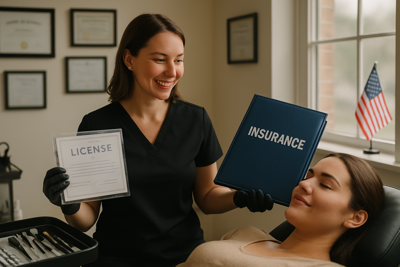
If you’re preparing to build a career in Microblading in the United States, understanding Licensing & Insurance for Microblading in United States is essential. This article walks you through the licensing landscape, the types of insurance policies you should consider, and practical steps to protect your business and clients. Whether you work from a salon, rent a suite, or operate as a mobile technician, the right credentials and coverage will keep your practice compliant and professional.
At Skinart United States, we’ve taught thousands of technicians worldwide how to navigate the regulatory and risk-management side of microblading. This guide is tailored for our United States students and outlines the differences between state rules, the typical insurance add-ons microblading artists need, and how to present credentialing information to clients and landlords.
Licensing & Insurance for Microblading in United States will be referenced throughout this post so you have a clear keyword to search for when checking state specific resources. We’ll also point you toward reliable official sources and practical next steps so you can focus on building a safe, legal, and profitable microblading service.
Table of Contents
- Overview: Why Licensing & Insurance Matter
- Licensing Requirements for Microblading
- Insurance Coverage Every Microblading Artist Should Consider
- How to Obtain Insurance & Typical Costs
- Compliance, Health Codes & Bloodborne Pathogen Training
- Common Licensing & Insurance Mistakes to Avoid
- Record-Keeping, Consent, and Incident Reporting
- State-by-State Variations and Local Examples
- Frequently Asked Questions
Using these anchor links helps search engines and readers jump straight to the section they need. Keep this page bookmarked as a quick reference while you set up or grow your microblading business.
Overview: Why Licensing & Insurance Matter
Licensing & Insurance for Microblading in United States aren’t optional extras — they form the foundation of a professional practice. Licensing confirms that you meet local health and safety standards; insurance protects you, your clients, and your business against unexpected claims such as accidental injury, allergic reaction, or property damage. For many clients, seeing proof of license and insurance is a minimum trust threshold before booking.
In the United States the regulation of microblading is fragmented: some states regulate microblading under tattooing laws, others under cosmetology or electrology statutes, and some cities or counties have their own additional requirements. That fragmentation means you must check municipal and state requirements where you plan to work. It’s also why having insurance that anticipates these regulatory differences is useful — it helps you continue to operate while you update paperwork or meet local conditions.
Beyond compliance, appropriate coverage reduces financial risk from claims and business interruption, and helps you qualify for rental agreements, salon partnerships, and even certain payment processors. We’ll walk through the typical licenses and insurance products microblading artists choose, plus step-by-step tips to secure both.
Licensing Requirements for Microblading
Most states fall into one of three regulatory buckets for microblading: regulated as tattooing, regulated under cosmetology/esthetician laws, or not explicitly regulated but overseen at the county/city level. Because rules change, always verify with your state health department and local county environmental health office. Licensing & Insurance for Microblading in United States are often required together when a local board inspects facilities or when a landlord asks for proof of compliance.
In many states where microblading is treated as tattooing, artists must obtain a tattoo practitioner license and operate from a permitted tattoo facility with specific sterilization and disposal procedures. In states that classify microblading under cosmetology, a cosmetology or esthetician license may be required first, followed by an additional body art permit. For mobile work, multiple jurisdictions may require separate permits or proof of a central hygienic location from which you operate.
Pros and cons lists below will help you choose the right path when a state gives you options:
- Pro: Proper licensing increases client trust and expands where you can book appointments.
- Con: Licensing processes can be time-consuming and include facility inspections and fees.
- Pro: A recognized license often reduces insurance premiums compared to unlicensed operators.
- Con: Some licenses require ongoing continuing education or renewals with associated costs.
Tip: If your state doesn’t specifically name microblading in statutes, seek guidance in writing from your local environmental health authority. A written determination can be invaluable when applying for insurance or negotiating rental agreements.
Skinart United States students frequently ask whether our microblading course satisfies licensing prerequisites. Our online microblading certification is CPD and BAQA accredited and forms a strong part of your portfolio and training documentation, but licensing is issued by local or state agencies and may require additional steps such as BBP training, local permits, or supervised practice hours. For state-specific guidance we recommend verifying requirements directly with the agency listed in the state resources section below.
Insurance Coverage Every Microblading Artist Should Consider
When discussing Licensing & Insurance for Microblading in United States the three most common and essential insurance types are: Professional Liability (also called Errors & Omissions for beauty professionals), General Liability, and Product Liability. Each serves a different purpose and together they cover typical exposures encountered by microblading artists.
Below are pros and cons of carrying comprehensive coverage:
- Professional Liability (Pro): Covers claims of negligent procedure, pigmentation errors, or scarring — often the most important for service-based claims.
- Professional Liability (Con): Claims can be subjective and may require detailed documentation; premiums can rise after a claim.
- General Liability (Pro): Protects against slips, trips, property damage, and client injuries that occur in your workspace.
- General Liability (Con): Does not cover professional errors related to treatment outcomes.
- Product Liability (Pro): Useful if using or selling pigments and aftercare products — covers allergic reactions or product defects.
- Product Liability (Con): May be unnecessary if you neither sell products nor use non-labeled supplies.
- Property & Contents (Pro): Covers equipment and supplies in a rented space or home studio.
- Property & Contents (Con): May not apply for mobile technicians without a fixed base; check terms for mobile use.
Additional endorsements to consider include cyber liability (if you store client notes and payment details online), sexual misconduct coverage depending on insurer wording, and hired-and-non-owned auto if you travel to clients or events. When researching policies, verify whether your insurer recognizes microblading as a covered practice and whether they impose restrictions on mobile services or on specific pigments or devices.
We recommend keeping the following documents ready when requesting quotes: copies of your CPD/BAQA certificates, any state license or facility permit, BBP certification if applicable, a sample client consent form, and a short description of your workspace (salon suite, home studio, or mobile setup). These speed the underwriting process and often reduce initial conditional exclusions.
How to Obtain Insurance & Typical Costs
Securing insurance for microblading involves three practical steps: selecting insurers who underwrite beauty and tattoo risks, preparing your documentation, and comparing quotes while checking policy wording carefully. Many mainstream insurers do not automatically include microblading under beauty policies, so you may need a specialist beauty or tattoo insurer. Prices vary by location, claims history, and whether you’re mobile or fixed location.
- Typical yearly cost for basic General + Professional Liability: $300–$900 depending on limits and location.
- Higher limits (e.g., $2M aggregate) or adding Product Liability/Property often pushes annual premiums into the $800–$1,800 range.
- Mobile endorsements or event coverage for conventions may add short-term fees or daily rates.
- Insurers often require evidence of training and sterilization protocols; expect conditional endorsements if you work from home.
- Some providers offer bundle discounts for CPD/BAQA-accredited students — always ask.
- Claims-made vs occurrence policies: understand which you’re purchasing; claims-made policies need tail coverage if you cancel mid-career.
- Security deposits, background checks, or professional references may be required by higher-tier insurers.
- Compare policy exclusions carefully — e.g., some policies exclude permanent makeup or micropigmentation unless added specifically.
When collecting quotes, ask the broker to provide a policy summary showing covered services, exclusions, insured limits, and renewal increases. Always confirm whether the policy covers work performed under another business name or in multiple states; many insurers require notification if you operate beyond the primary address listed on the policy.
Skinart United States students often ask about cost-saving strategies: maintaining a clean claims-free history, keeping documentation organized, and investing in approved sterilization processes can make you a preferred risk for insurers, which in turn lowers your premium. If you’re in a state with ambiguous regulation, share any written determinations from local health authorities with your broker — they can be decisive for underwriting.
Compliance, Health Codes & Bloodborne Pathogen Training
Regulatory compliance for microblading is heavily focused on infection control, sterilization, and waste disposal. Most states that regulate body art require artists to follow OSHA guidelines and to complete Bloodborne Pathogen (BBP) training. Even where BBP is not mandatory, carrying documentation of BBP completion improves your credibility for rental spaces and insurers.
Typical compliance elements that local health inspectors look for include: sharps disposal containers, single-use disposables where recommended, written sterilization procedures, up-to-date client consent forms, and properly labeled pigments and solution containers. Insurers will often ask for evidence of these controls during underwriting.
Quote from an industry official: “Local health departments commonly view microblading through the lens of bloodborne pathogen risk,” says a municipal health inspector in Portland. “When an operator demonstrates clear written protocols and BBP training, it reduces the likelihood of enforcement action.” Use those words as a reminder: good records lower both regulatory and insurance risk.
- Complete an accredited BBP course and keep the certificate on file.
- Maintain written sterilization and cleaning logs for instruments and surfaces.
- Use single-use disposable needles and pigment containers when required by law.
- Store pigments and aftercare products per manufacturer guidance and keep MSDS sheets available.
- Provide and archive signed client consent forms and pre-service screening checklists.
- Use EPA-registered disinfectants appropriate for body art settings.
- Document staff training and continuing education to support claims defense.
- Ensure your workspace has appropriate lighting and surfaces that can be sanitized.
Common Licensing & Insurance Mistakes to Avoid
- Operating without checking both state and county/city rules — microblading may be regulated at a local level.
- Assuming your homeowner’s or renter’s policy covers a business — most personal policies exclude business activities.
- Buying the cheapest policy without reviewing exclusions — some policies exclude micropigmentation explicitly.
- Failing to disclose mobile services — insurers may require an add-on for off-site treatments.
- Not keeping signed consent forms or client photos — these are critical for defending a professional liability claim.
- Using non-sterile instruments or reusing needles — this can void coverage and trigger regulatory action.
- Sharing equipment between artists without written agreements — introduces cross-liability issues.
- Not updating insurers after a move or change in service type — an unreported change can invalidate coverage.
- Assuming BAQA/CPD certification replaces state licensing — training helps, but licensing authority is separate.
- Ignoring policy limits — high-value claims can exceed low-limit policies quickly.
Each of these mistakes can have serious business consequences, from denied claims to fines and forced closure. For example, a student in Texas once shared that operating without a clearly documented sanitary protocol led to a notice from a county health inspector; because paperwork was inconsistent, the inspector treated it as an enforcement issue rather than an educational opportunity. Proper documentation and the right insurance prevented a costly closure, but the scare was avoidable.
The best defense is proactive: keep up-to-date certificates, a clearly written client consent and aftercare checklist, and an insurance broker who understands microblading. Skinart United States recommends discussing your business model with your insurer before you begin operations so you can make an informed decision on endorsements and limits.
Record-Keeping, Consent, and Incident Reporting
Strong records protect you in three ways: they demonstrate compliance during inspections, support your defense if a client makes a claim, and help you review and improve your protocols. For licensing & insurance purposes, maintain digital and physical copies of client consent forms, pre-screening notes, treatment photos, pigment batch numbers, and aftercare instructions.
Incident reporting is another critical area. If a client experiences an adverse event — an infection, unexpected reaction, or injury — document the date, time, treatment notes, communications, and any third-party medical reports. Notify your insurer promptly; many policies require timely reporting to preserve rights under the policy.
- Keep client records for the period required by your local regulator (often 3–7 years).
- Record pigment batch numbers and expiration dates for traceability.
- Take standardized before-and-after photos with consistent lighting.
- Retain signed consent and aftercare instructions and log any follow-up contact.
- Use secure storage for client medical notes and personal data to protect privacy.
- Report incidents to your insurer immediately; late notice can result in denial of coverage.
- When in doubt, consult a legal advisor on mandatory reporting to public health authorities.
- Consider a simple incident logbook for quick reference during audits or claims.
State-by-State Variations and Local Examples
Because each U.S. state approaches microblading differently, we summarize common examples to help you research your jurisdiction. Note: always verify with official sources; the descriptions below are illustrative and not exhaustive.
Examples:
- California (example): Many counties treat microblading as tattooing, requiring a body art permit and an approved facility. BBP training and local inspections are common.
- Texas (example): Some counties allow microblading under cosmetology or esthetician rules if pigment is applied superficially; other counties treat it as tattooing — local verification is essential.
- Florida (example): Several counties require a body art facility permit and routine inspections; mobile operators often must register the vehicle and central location.
- New York City (example): NYC Health has clear guidance for tattooing and body art; artists typically undergo inspections and must meet sanitation standards.
- Arizona (example): Variability across counties; some permit microblading with an esthetician license plus a local permit.
- Illinois (example): Certain counties treat microblading like tattooing; requiring sharps containers, single-use supplies, and a permit.
- Ohio (example): Some boards are updating language to explicitly include micropigmentation; always check the state board for recent rule changes.
- Local success story: A Skinart United States graduate in Colorado navigated county requirements by securing a written clarification from the county health department and used that to obtain tailored insurance that allowed her to sign a salon sublet agreement within three weeks.
Helpful authoritative resources include state health department websites and municipal environmental health pages. Where possible, request written confirmation of local interpretations — these documents are invaluable when applying for permits or negotiating with insurers and property owners.
Frequently Asked Questions
Q: What documentation should I bring to an insurer?
A: Bring your course certificates (CPD/BAQA), any state or local permits, BBP certificate if available, a sample consent form, and a brief description of your workspace and services.
Q: Will a salon require proof of insurance before letting me sublet a chair?
A: Yes — most salons and landlords require proof of General Liability and may request professional liability depending on the services you offer. Having both helps secure agreements faster.
Q: Are pigments regulated?
A: Pigment regulation varies. Keep MSDS and manufacturer documentation for each pigment and record batch numbers. Some local health boards require this documentation during inspections.
Final Thoughts & Next Steps
Licensing & Insurance for Microblading in United States may seem complex, but with a step-by-step approach you can make your practice safe, legal, and attractive to clients. Start by researching your state and local health department requirements, complete accredited training (like Skinart’s CPD and BAQA-accredited microblading course), obtain BBP certification, and consult with a broker who understands body art risks.
Make documentation a habit: tidy consent forms, photos, pigment records, and training certificates form a strong defensive record that underwriters and inspectors respect. Over time, consistent compliance and good client care will decrease your insurance premiums and open doors to partnerships, salon space rentals, and professional growth.
Written by Gary Erskine, 25+ years in Licensing & Insurance for Microblading in United States education and training. If you want support through licensing and insurance preparation tailored to your state, our online course includes clear guidance to help you present the documentation insurers and regulators expect.
Ready to Start? Protect Your Career
Enroll in Skinart United States’ CPD and BAQA-accredited Online Microblading Course to gain the skills and certified training records insurers and regulators expect. We focus on technique, safety, and the documentation you need to operate with confidence in the United States.
Recent Blog Posts
- Studio Etiquette Update: Professionalism in 2026
 Workplace Etiquette for Body Art Studios Refresh your studio etiquette and build a reputation for professionalism with these up-to-date best practices.… Read More »Studio Etiquette Update: Professionalism in 2026
 - 🌙 Eid Mubarak: Celebrate with 5% Off in 2026!
 Eid Savings: 5% Off All Courses Celebrate Eid with a special offer: 5% off any course. Use code EID5 at checkout.… Read More »🌙 Eid Mubarak: Celebrate with 5% Off in 2026!
 - Top Mistakes New Body Artists Should Avoid (2026)
 Stay Ahead: Common Pitfalls for New Artists Read up on the most frequent errors new body artists make, and how to… Read More »Top Mistakes New Body Artists Should Avoid (2026)