Ear Piercing vs Body Piercing: Which to Start With?
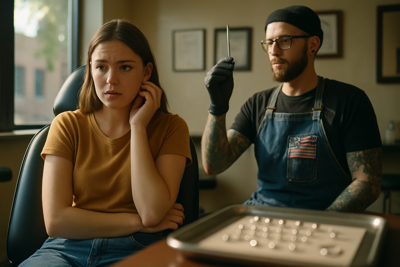
Choosing between ear piercing and body piercing is the first practical decision most newcomers to professional piercing face. Whether you’re imagining a focused career in lobes and helixes or dreaming of offering dermal, navel, and nipple work, understanding the differences early is essential. This guide explores Ear Piercing vs Body Piercing so you can make an informed, confident start in the United States.
At Skinart United States we specialise in accredited piercing education designed for beginners and experienced artists alike. In this article you’ll find clear comparisons, practical considerations, common mistakes, and a recommended learning path that aligns with local regulations and best practice. If you’re weighing the choice between starting with ear piercing vs body piercing, read on—this is written to help you decide and take the next step with confidence.
Written by Gary Erskine, 25 years in body art education — lead tutor at Skinart United States. Gary has trained thousands of students worldwide and helped many set up compliant, successful piercing services in the US market.
Table of Contents
- What are the core differences between ear piercing and body piercing?
- Pros and cons: Ear piercing vs body piercing
- Skills and techniques you’ll learn
- Common mistakes beginner piercers make
- Safety, regulation and training in the United States
- Equipment, shop setup and practical considerations
- Building a career: which path pays off?
- FAQ — Ear Piercing vs Body Piercing
- Final thoughts and next steps
Tip: Use the section links above to jump to the parts most relevant to you — search engines may show “Jump to” links if the headings are anchored.
What are the core differences between ear piercing and body piercing?
When people compare Ear Piercing vs Body Piercing they’re often looking at three main dimensions: anatomy, technique, and aftercare. Ear piercing typically focuses on specific cartilaginous and lobular zones with predictable anatomy and lower procedural complexity. Body piercing covers a wider range of anatomy — from navel and tongue to more sensitive zones such as nipples and genitalia — and often requires advanced knowledge of tissue types and healing patterns.
Ear piercing is frequently taught as the entry-level skill because it gives new piercers a controlled environment to learn aseptic technique, landmarking, and simple jewellery insertion. Body piercing requires additional training in pain management, complex placement, jewellery selection for surface vs through-tissue placements, and a higher degree of client assessment.
From a business perspective in the United States, ear services are high-volume and lower-risk when done correctly, while body piercing can command higher fees but carries more regulatory attention, especially in certain municipalities and states. As you decide which to start with, consider your goals: repeatable, fast services for steady income (ear) versus differentiated, higher-margin services that require more skill (body).
Pros and cons: Ear piercing vs body piercing
Here’s a compact comparison to make the choice clearer:
- Pros — Ear Piercing: Fast procedures, high client demand, straightforward aftercare, excellent for building confidence and client relationships.
- Cons — Ear Piercing: Lower average ticket price per service; high competition in many markets.
- Pros — Body Piercing: Higher fees for advanced procedures, ability to specialise (oral, surface, genital), potential for reputation as a skilled piercer.
- Cons — Body Piercing: More complex anatomy, longer healing times, increased regulatory scrutiny in some states and municipalities.
Both paths are valid and profitable. Many successful piercers start with ear piercing to master hygiene, client handling, and basic placements, then broaden into body piercing once comfortable. The decision to specialise early or remain generalist should be driven by local demand and the kinds of clientele you want to attract.
Keep in mind that in the United States regulations vary. Some cities require specific licensing or supervisor arrangements before you can perform certain body piercings. We cover these topics in our training so you can open services confidently and compliantly.
Skills and techniques you’ll learn
Whether you start with ear piercing or body piercing, training will cover common foundations like infection control, client consultation, consent and record keeping, and basic aftercare. From there, the technical skills diverge.
Ear piercing focuses on: placement mapping for lobes and cartilage, use of sterile instruments, single-use needles vs. cannula techniques, and jewellery sizing. Body piercing includes more advanced skills: tissue assessment for navel and surface piercings, oral anatomy for tongue and labret work, and safe protocols for sensitive areas.
Below are practical skills you can expect to practice during accredited training:
- Professional client consultation and informed consent
- Aseptic technique and standard precautions (BBP awareness)
- Landmarking and placement for lobes, helix, tragus, and forward helix
- Surface anatomy and assessment for navel, nipple, and surface piercings
- Oral anatomy considerations for tongue and labret piercings
- Appropriate jewellery selection: metals, gauges, and shapes
- Aftercare planning and complication recognition
- Client records, local regulation awareness, and referral pathways
Common mistakes beginner piercers make
- Poor landmarking or inconsistent placement — leads to migration or poor aesthetics
- Incorrect jewellery selection (wrong gauge or poor-quality metal)
- Inadequate client consultation — missing medical history or medication checks
- Rushing the aseptic setup and reusing non-sterile items
- Overlooking state and local regulations — exposing yourself and clients to risk
- Not recognising early signs of rejection or infection
- Poor aftercare advice — causing delayed healing
- Attempting advanced body placements without sufficient supervised practice
These mistakes are common but preventable. The Skinart online piercing course emphasises hands-on practice plans (simulation and supervised images review), evidence-based aftercare, and checklists designed to remove guesswork. Your first priority as a developing piercer should always be client safety and predictable outcomes.
As an industry tutor based in the United States, I often tell students: master the basics with ear piercing, then expand. An experienced piercer who transitions to body work after strong fundamentals will progress faster and safer.
Safety, regulation and training in the United States
Regulation for piercing is not uniform across the US — each state and often municipalities set their own requirements. Some locations require bloodborne pathogen (BBP) training, sanitary inspections, and even written consent forms specific to minors. Our Skinart course covers national best practices and points you to local resources so you can check the specific rules that apply where you intend to work.
Safety starts with a proper training pathway. Accredited courses that align with CPD Standards and industry associations include detailed modules on cross-infection control, record keeping, and client assessment. We also recommend checking local public health pages and official guidance. For example, the Centers for Disease Control and Prevention (CDC) provides useful information on body art safety that complements practical training.
- Complete accredited BBP and infection control modules
- Follow written consultation and consent protocols
- Keep up to date with state and county health department rules
- Document procedures and aftercare instructions thoroughly
- Refer clients to medical professionals for complex medical histories
- Implement a waste disposal and sharps protocol for your studio
- Regularly refresh practical skills under supervision or mentorship
- Stay informed about material safety (nickel-free options, implant-grade metals)
Equipment and practical setup (what you need to know)
Equipment and sterile setup are common concerns when choosing between ear piercing vs body piercing. Ear services can often be performed with streamlined setups: single-use sterile needles, sterile forceps, and starter jewellery. Body piercing typically demands additional tools (longer needles, curved or specialty clamps, and different jewellery types), a careful waste protocol, and sometimes a larger treatment area.
Important note for prospective Skinart students in the United States: Skinart United States provides accredited training and course materials, but we do not supply piercing equipment as part of the course. You will learn exactly what to buy and how to validate suppliers to meet US safety standards. We guide you through trusted specifications so you can source appropriate implant-grade metals and sterile consumables locally.
- Sterile single-use needles and appropriate needle sizes
- Sterile gloves, antiseptics, and skin prep solutions
- Sterile forceps, clamps (where appropriate), and measuring tools
- Implant-grade jewellery (titanium, implant-grade steel)
- Sharps containers and local-compliant waste disposal plans
- Documentation templates for client records and consent
- Aftercare literature you can give to clients
- Basic studio setup checklist and cleaning protocols
Building a career: which path pays off?
There’s no single answer to whether ear piercing vs body piercing is the better business choice — both can be financially rewarding. If you want consistent daily revenue and quick client turnover, ear piercing is a great place to start. If you prefer specialised, higher-ticket work and building a niche reputation, body piercing offers greater differentiation.
Many successful piercers follow a hybrid approach: start with ear piercing to build technical competence and retail relationships (jewellery sales, aftercare products), then add body services once they have a reliable client base and the required training. The Skinart online piercing course is structured to support this pathway: foundational modules first, then advanced modules focused on body placements, anatomy, and complication management.
Local success stories in the United States often reflect this progression. A recent student in Austin, Texas began by offering ear services at pop-up events while completing advanced training; within a year she expanded to a small booth and added navel and dermal work. Progress like this is common when the foundations are solid.
FAQ — Ear Piercing vs Body Piercing
Which should I learn first: ear piercing or body piercing?
Begin with ear piercing if you are new to professional body art — it teaches landmarking, sterile workflow, and client communication in a repeatable, lower-risk context before you progress to more complex body work.
Is ear piercing a good long-term career?
Yes. Ear piercing can sustain a long-term career, particularly when combined with retail jewellery sales and good marketing. Many piercers start with ears and later add body services to grow revenue.
Does the Skinart course teach body piercing techniques online?
Skinart United States offers an accredited online piercing course that covers both ear and body piercing theory, anatomy, and practical planning. Practical supervised practice is encouraged via mentorship and portfolio submission; we do not provide in-person training in the United States.
Do I need special licensing to do body piercings in my city?
Requirements vary by state and municipality. We recommend checking your local health department and completing the CPD-aligned safety training modules to meet common requirements like BBP certification and sanitary standards.
What are the most common complications with body piercings?
Complications include infection, migration, rejection (particularly with surface piercings), and allergic reactions to low-grade metals. Proper placement, jewellery choice, and follow-up care significantly reduce these risks.
Final thoughts — choosing your starting path
Ear Piercing vs Body Piercing is not an either-or decision for many students. The most pragmatic pathway is to begin with ear piercing to build competency, confidence and a client base, then progress to body piercing once you have a solid foundation. This approach balances safety, regulatory compliance, and business growth.
Remember: the best piercers are those who invest in ongoing education and follow best-practice safety standards. Training that combines clear theory with practical guidance, checklists and mentorship will accelerate your progress more than rushing into advanced services unprepared.
If you’re in the United States and ready to start — whether your goal is to master ear piercing or to become a full-spectrum body piercer — the Skinart accredited online piercing course gives you the tools, assessments and industry-recognised accreditation to move forward professionally.
Ready to start? Get accredited and confident
Join Skinart United States’ CPD-accredited online piercing course to learn the fundamentals of ear piercing and safely progress into body piercing. The course is built for the US market and covers regulation guidance, clinical safety, and practical planning.
Latest Blog Posts
- Studio Etiquette Update: Professionalism in 2026
 Workplace Etiquette for Body Art Studios Refresh your studio etiquette and build a reputation for professionalism with these up-to-date best practices.… Read More »Studio Etiquette Update: Professionalism in 2026
 - 🌙 Eid Mubarak: Celebrate with 5% Off in 2026!
 Eid Savings: 5% Off All Courses Celebrate Eid with a special offer: 5% off any course. Use code EID5 at checkout.… Read More »🌙 Eid Mubarak: Celebrate with 5% Off in 2026!
 - Top Mistakes New Body Artists Should Avoid (2026)
 Stay Ahead: Common Pitfalls for New Artists Read up on the most frequent errors new body artists make, and how to… Read More »Top Mistakes New Body Artists Should Avoid (2026)