Piercing License Explained: What You Need to Know
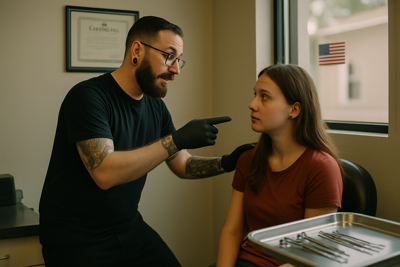
Piercing License Explained: this guide breaks down what the term really means for aspiring piercers, studio owners, and clients across the United States. Whether you’re exploring a career in body modification or looking to open a compliant piercing studio, understanding licensing, local regulations, insurance, and training requirements is essential. This article walks you through each step, clarifies common confusion, and points you to practical next steps.
At Skinart United States, we know the responsibility that comes with professional piercing. Our online Piercing course is built around safe practice, anatomy, blood-borne pathogen control, and the documentation you’ll need to satisfy many municipal and state authorities. Read on to get the full picture of what a piercing license is, how to get one, and how to stay compliant in the U.S.
Written by Gary Erskine, 25+ years in body art education. Gary has trained thousands of students worldwide and contributed to standards used by studios and licensing bodies. The information below is tailored for readers in the United States and reflects common practices, typical requirements, and first-hand guidance to help you move forward confidently.
Table of Contents
Use the links below to jump to the section you need. We add semantic IDs to each major heading so search engines and browsers can create “Jump to” links.
- Overview: What a Piercing License Is
- Why a Piercing License Matters in the U.S.
- Common Licensing & Training Requirements
- Practical Steps to Get Licensed
- Common Mistakes that Delay Licensing
- Insurance, Liability & Health Codes
- State & City Examples from the United States
- Frequently Asked Questions
- Final Thoughts & Next Steps
Overview: What a Piercing License Is
The phrase “piercing license” can mean different things depending on local law. In many U.S. cities and counties, it refers to a permit or registration that studios and practitioners must hold before performing body piercings. In some jurisdictions the requirement is targeted at the facility (a business license or health permit), while in others specific practitioner registration and proof of training are required. Understanding the distinction — facility permit vs practitioner license — is the foundation of compliance.
Piercing License Explained: conceptually, it combines training verification, infection control credentials, facility inspections, and sometimes age-verification procedures for clients. The goal is always public safety: preventing blood-borne infections, ensuring sterile technique, and protecting consumers with clear standards for consent and aftercare.
Across the United States there is no single national “piercing license” — rather, a patchwork of municipal and state rules. That means prospective piercers and studio owners need to review local health department regulations and often meet several overlapping requirements. Skinart United States helps students prepare for these real-world expectations by teaching best practice, documentation standards, and the practical skills regulators expect to see.
Why a Piercing License Matters in the U.S.
Licensing protects both the public and professionals. When a studio and its staff are licensed or registered, clients have clear assurance of minimum hygiene standards, trained practitioners, and transparent record-keeping. For piercers, licensing demonstrates legitimacy and builds trust with clients and regulators.
- Pros: Higher client trust, lower infection risk, smoother inspections, and easier business banking/licensing interactions.
- Cons: Administrative cost, time for required courses and documentation, and sometimes recurring renewals or fees.
Understanding the benefits and limitations of a piercing license helps you plan. For example, many clients choose licensed studios precisely because they want hygienic procedures and clear aftercare. Studios that engage proactively with licensing processes can also avoid fines, forced closures, or reputational damage that comes from failing an inspection.
At Skinart United States, our Piercing course is crafted to align with the practical standards often requested by local health departments and studio owners. While we cannot issue a municipal license, our certification and training documentation can be used to support practitioner registration in many U.S. jurisdictions.
Common Licensing & Training Requirements
While requirements vary, many municipalities and health departments ask for similar documentation and training. Preparing these items in advance speeds up approvals and reduces the likelihood of inspection issues. The list below summarizes what you’ll frequently encounter when pursuing a piercing license or registration in the United States.
Piercing License Explained practically: regulators want evidence of competency (training certificates), infection control (BBP/OSHA awareness), facility cleanliness, and responsible business practice (consent forms, client records, proper waste disposal).
Below is a comprehensive checklist of typical requirements you may need to satisfy. Keep in mind that some states are stricter than others; always check your local health department for exact wording.
- Formal piercing course certificate showing anatomy, sterile technique, and aftercare knowledge
- Blood-borne pathogen (BBP) awareness or certification
- Proof of age and legal right to work in the U.S.
- Facility permit or health department inspection for the studio
- Proper sharps and biomedical waste disposal plan
- Written client consent forms and aftercare instructions
- Standard operating procedures (SOPs) for sterilization, cleaning, and incident reporting
- Proof of insurance or liability coverage (when required)
- Record-keeping systems for client histories and procedures
- In some areas, a background check or fingerprinting for practitioners
Practical Steps to Get Licensed or Registered
Ready to move forward? The path to compliance usually follows a logical sequence. Below are practical steps you can take whether you’re starting as an independent piercer or preparing a studio for inspection.
- Research local health and licensing regulations for your city/county — contact the health department or check its website
- Complete a recognized piercing training course that covers anatomy, infection control, and safe technique
- Obtain BBP awareness and any other health certifications required locally
- Prepare the studio for inspection: SOPs, consent forms, cleaning logs, and proper waste plans
- Apply for the facility permit and/or practitioner registration with required documents
- Schedule any necessary inspections and correct issues promptly
- Purchase appropriate liability insurance if required or recommended
- Maintain records and renew any permits before expiry
Each step involves documentation. For training, keep a clear certificate that names the course content and the issuing organisation. At Skinart United States we provide a detailed certificate and supporting documentation tailored to common U.S. requirements that students can present to their local health departments.
It’s worth noting: some localities accept online training plus practical verification, while others require evidence of supervised practical experience. If your locality asks for supervised practice, approach reputable studios for mentorship or apprenticeships to meet those criteria.
Common Mistakes that Delay Licensing
Even experienced practitioners can hit setbacks when applying for local permits. Avoiding these predictable pitfalls saves time and money. Below are the most common mistakes we see, and how to prevent them.
- Submitting incomplete paperwork — missing signatures, unclear course descriptions, or absent BBP proof
- Using training that doesn’t meet local criteria — e.g., a certificate lacking hands-on content when the city requires it
- Failing to prepare the facility for inspection — no SOPs, improper sharps disposal, or no cleaning logs
- Assuming statewide rules are identical — many requirements are municipal, not state-level
- Not maintaining accurate client records and aftercare instruction logs
- Neglecting to check for renewal dates and letting permits lapse
- Purchasing low-cost or uncertified supplies that fail inspection
- Overlooking age verification laws for minors — some jurisdictions prohibit piercing minors or require parental consent
Most of these mistakes are administrative rather than technical, which means they’re straightforward to fix with the right checklist. Skinart students receive templates for consent forms, aftercare instructions, SOP examples, and a breakdown of documentation that many health departments accept.
One practical tip: before applying, call your local health department and ask for an inspector’s checklist. Many health departments will provide guidance that makes the inspection process transparent and achievable.
Insurance, Liability & Health Codes
Insurance is often overlooked but essential. Liability insurance protects you and your business if a client alleges harm following a procedure. Some municipalities or landlords may require proof of coverage before allowing operations. Even if not required, insurance is a responsible business practice.
Health code compliance centers on preventing infection and proper waste disposal. Typical code items include safe sharps containers, appropriate disinfectants, clear manufacturer instructions for instrument sterilization (if using autoclaves), and documentation of sterilizer maintenance and spore tests where applicable.
Below is a quick checklist to discuss with your insurer and local health department. It ensures your operation aligns with typical U.S. expectations and reduces the risk of sanctions.
- General liability insurance and professional liability (if available) that covers piercing procedures
- Proof of sharps disposal contract or plan with an approved biomedical waste vendor
- Documentation of sterilizer testing, maintenance logs, and sterilization SOPs
- Client intake forms, consent forms, and aftercare records kept for a recommended period
- Employee training logs and certificates for all staff performing piercings
- Written infection control plan aligned with OSHA and local health recommendations
- Clear signage and age-verification procedures for minors
- Emergency procedures and record of employee first-aid or CPR training
State & City Examples from the United States
Because rules differ widely, here are illustrative examples from several U.S. locations to show how varied requirements can be. These examples are not exhaustive or authoritative — always consult the local health department for definitive requirements — but they illustrate the range of possible expectations.
Example 1 — New York City: NYC requires body art practitioners and facilities to follow specific rules published by the Department of Health. Many body art businesses must register and meet sanitization and recordkeeping requirements.
Example 2 — California: Several California cities have municipal codes that include body art oversight. In some counties, health departments ask for written SOPs, proof of BBP training, and sometimes proof of practical competency.
- New York City — registration and inspection model with facility-focused permits
- Los Angeles County — county-level public health guidance and potential facility inspection
- Chicago — municipal codes addressing facility sanitation and practitioner responsibilities
- Houston — local health ordinances and business licensing combined
- Smaller municipalities — often require minimal registration but still demand BBP and SOP documentation
- Some states have limited statewide guidance, leaving details to cities and counties
- Municipalities with active tourism sectors often have stricter enforcement to protect visitors
- Always check for local age limits and consent rules for minors — they vary significantly
To find specifics for your area, search for your city or county health department plus “body art” or “piercing” — e.g., “Los Angeles County body art permit.” You can also contact the health department’s business licensing or environmental health division for guidance. For federal guidance on blood-borne pathogens and workplace safety, the OSHA website is a useful reference.
Authoritative resources: the U.S. Centers for Disease Control and Prevention (CDC) publishes guidance around infection control and safe piercing practices — see the CDC’s website for general infection prevention recommendations. Local health department pages provide the regulatory specifics you’ll need for licensing.
Frequently Asked Questions
Below are common questions people search for when looking up “Piercing License Explained.” Each answer is concise and practical for U.S.-based readers.
Do I need a license to perform piercings in the United States?
It depends on your city or county: many jurisdictions require facility permits and/or practitioner registration, while some have minimal or no specific requirements. Always check local health department rules to confirm.
What training is typically required for a piercing license?
Most areas expect proof of infection control (BBP), anatomy knowledge, and safe piercing technique. Some require supervised hands-on training or proof of practical experience in addition to theoretical instruction.
Can an online course help me get licensed?
Many localities accept online training combined with documented practical experience; others expect in-person skills verification. Our online Piercing course provides a comprehensive certification package that supports many local application processes, but always confirm acceptance with your local authority.
How much does licensing typically cost?
Costs vary widely — from modest registration fees in small towns to larger permitting and inspection fees in major cities. There may also be costs for insurance, training, and facility upgrades required to pass inspection.
What if my city doesn’t have specific piercing rules?
Even if there aren’t piercing-specific rules, general health, sanitation, and business regulations still apply. Implementing best practice and maintaining clear client records, written consent, and infection control procedures is still essential.
Final Thoughts & Next Steps
Piercing License Explained: summed up, a license is documentation and approval from the appropriate authorities that your practice or facility meets public-safety standards. Because regulation is local, the smartest first move is to check with your city or county health department, then align your training and paperwork to meet those expectations.
For aspiring piercers, the right training gives you both confidence and the paperwork to present to regulators and potential employers. For studio owners, proactive compliance reduces risk and builds client trust. At Skinart United States we focus on delivering training, documentation, and templates that match what health departments typically request in the U.S.
If you’re ready to learn the technical skills, infection control, and paperwork best practice that many authorities require, consider the Skinart online Piercing course. It’s designed to prepare you for licensing conversations and for safe, professional practice in the field. Take the next step to become a confident, compliant practitioner.