Understanding contamination is part of preparing for body-art training. Use these questions to organise your learning, identify gaps and discuss the correct procedure with your tutor.
Think about the sequence, not just the supplies
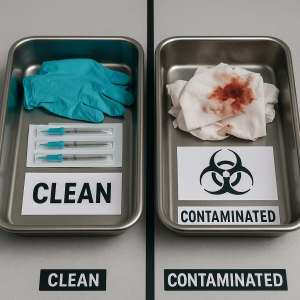
Cross-contamination is the transfer of contamination between people, equipment or surfaces. A neat-looking workspace is not enough to explain how that transfer is prevented. During training, learn the reason for each step and how the steps fit together.
This article is a study companion, not a procedure for working on a person. Follow the practical instructions, assessment and supervision arrangements supplied with your course.
Map the points you need to understand
Draw a simple workspace on paper. Mark supplies, the practice area, frequently touched objects and the route for used materials. Then ask your tutor to review the drawing. Focus on questions you cannot yet answer rather than treating your first sketch as an approved setup.
- Where are unused materials kept?
- Which objects might be touched during an interruption?
- What happens when a required item has been forgotten?
- Which instructions explain the handling of used equipment and waste?
- Who should be asked if the sequence becomes unclear?
Keep product instructions with your notes
Record the exact equipment or product used in a demonstration. Avoid assuming that an instruction applies to a different product with similar packaging. Ask your tutor where the relevant manufacturer instructions are kept and how they are used alongside the course procedure.
Do not reduce cleaning, disinfection and sterilisation to a single vague instruction to “clean everything”. Make sure you understand how the course distinguishes these terms and which process is intended for each item.
Review one uncertainty at a time
Bring a specific question, a diagram or a note from the lesson to your tutor. Record the answer beside the original question and revisit the relevant lesson before the next assigned exercise. A written checklist is useful only when you understand it and it reflects the instructions you have actually been given.
A study exercise to try on paper
Trace an interruption on paper: the learner stops to check a phone, then wants to return to an exercise. List what may have been touched and where the approved procedure needs clarification. Ask your tutor to review the sequence; do not treat the exercise as permission to improvise an infection-control procedure.
Find the reference for your location
CDC healthcare guidance explains that gloves do not replace hand hygiene. This is useful background for studying contamination, but the page is written for healthcare settings; it is not a tattoo-business licensing guide. Check the authority responsible for the location where you intend to work and the procedure-specific instructions used in your training.
Reference: CDC: Clinical Safety and Hand Hygiene.
Connect the reading to your course
Review the curriculum and practical requirements in the regional course catalogue. Ask the team which lessons cover your chosen discipline. Reading guidance does not replace practical assessment or establish permission to provide a service.