Piercing License Explained: What You Need to Know
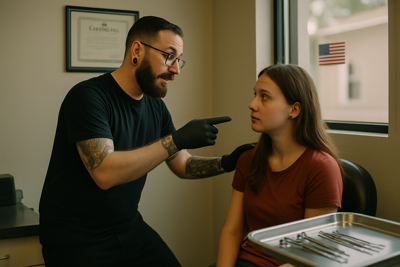
Piercing License Explained: this guide breaks down what the term really means for aspiring piercers, studio owners, and clients across the United States. Whether you’re exploring a career in body modification or looking to open a compliant piercing studio, understanding licensing, local regulations, insurance, and training requirements is essential. This article walks you through each step, clarifies common confusion, and points you to practical next steps.
Use this guide to organize questions about practitioner requirements, premises approval and training evidence. Compare the current online piercing course with the requirements for your intended location before enrolling.
Table of Contents
Choose a section to find the information you need.
- Overview: What a Piercing License Is
- Why a Piercing License Matters in the U.S.
- Common Licensing & Training Requirements
- Practical Steps to Get Licensed
- Common Mistakes that Delay Licensing
- Insurance, Liability & Health Codes
- State & City Examples from the United States
- Frequently Asked Questions
- Final Thoughts & Next Steps
Overview: What a Piercing License Is
The phrase “piercing license” can mean different things depending on local law. In many U.S. cities and counties, it refers to a permit or registration that studios and practitioners must hold before performing body piercings. In some jurisdictions the requirement is targeted at the facility (a business license or health permit), while in others specific practitioner registration and proof of training are required. Understanding the distinction — facility permit vs practitioner license — is the foundation of compliance.
Identify the actual permit or registration rather than treating “piercing license” as one standard credential. Ask the issuing authority what it covers, who holds it and where it is valid.
Start with the authority responsible for body piercing at your proposed address. Ask which requirements apply to the practitioner and which apply to the premises, and keep the written responses with your planning records.
Why a Piercing License Matters in the U.S.
Check the validity and scope of any required approval. A current permit is relevant evidence, but it does not guarantee a particular procedure will be risk-free or that every practitioner holds the same training.
- Planning benefit: knowing the required approvals helps you identify documents, costs and dependencies before opening.
- Cons: Administrative cost, time for required courses and documentation, and sometimes recurring renewals or fees.
Keep the approval conditions alongside your operating records. Ask the authority about any changes to premises, practitioners or services that require notification or a new application.
A course certificate does not issue a local licence or establish acceptance by an authority. Ask the relevant office what training and assessment evidence it requires, then compare those requirements with the actual course information.
Common Licensing & Training Requirements
Use the topics below to ask what applies to your intended service and address. They are research prompts, not a universal application checklist.
Request the current application instructions and supporting-document list from the responsible authority. Record any training or practical experience requirements separately from premises requirements.
Confirm which of the following items is required, which office receives it and what evidence it accepts.
- Formal piercing course certificate showing anatomy, sterile technique, and aftercare knowledge
- Blood-borne pathogen (BBP) awareness or certification
- Any applicant identification or eligibility evidence specified in the application instructions
- Facility permit or health department inspection for the studio
- Proper sharps and biomedical waste disposal plan
- Written client consent forms and aftercare instructions
- Standard operating procedures (SOPs) for sterilization, cleaning, and incident reporting
- Proof of insurance or liability coverage (when required)
- Record-keeping systems for client histories and procedures
- Any additional applicant checks explicitly required by the responsible authority
Practical Steps to Get Licensed or Registered
Ready to move forward? The path to compliance usually follows a logical sequence. Below are practical steps you can take whether you’re starting as an independent piercer or preparing a studio for inspection.
- Research local health and licensing regulations for your city/county — contact the health department or check its website
- Confirm the training and practical assessment requirements before choosing a course.
- Obtain BBP awareness and any other health certifications required locally
- Prepare the studio for inspection: SOPs, consent forms, cleaning logs, and proper waste plans
- Apply for the facility permit and/or practitioner registration with required documents
- Schedule any necessary inspections and correct issues promptly
- Purchase appropriate liability insurance if required or recommended
- Maintain records and renew any permits before expiry
Keep the actual certificate, syllabus and assessment information together. Ask the course team which documents it supplies and send those documents to the relevant authority if requested. Do not assume that a training certificate is tailored to every US application process.
Ask the relevant authority whether it requires supervised experience and what evidence is accepted. Confirm those details before arranging a placement; do not assume a course purchase includes a local apprenticeship.
Common Mistakes that Delay Licensing
Review the application against the issuing authority’s instructions before submission. The following checks can help you find missing information without assuming approval or a fixed processing time.
- Submitting incomplete paperwork — missing signatures, unclear course descriptions, or absent BBP proof
- Using training that doesn’t meet local criteria — e.g., a certificate lacking hands-on content when the city requires it
- Failing to prepare the facility for inspection — no SOPs, improper sharps disposal, or no cleaning logs
- Checking only one level of government without confirming which state and local requirements apply
- Not maintaining accurate client records and aftercare instruction logs
- Neglecting to check for renewal dates and letting permits lapse
- Buying supplies without confirming the required specifications and supporting documentation
- Overlooking age verification laws for minors — some jurisdictions prohibit piercing minors or require parental consent
Keep a list of the documents requested by the authority. Ask the training team which course documents it supplies, and arrange any additional records separately. A template must be checked against the requirements for its intended use.
One practical tip: before applying, call your local health department and ask for an inspector’s checklist. Many health departments will provide guidance that makes the inspection process transparent and achievable.
Insurance, Liability & Health Codes
Discuss the proposed procedures, practitioners and premises with an insurance professional. Request written confirmation of the scope, conditions and exclusions rather than assuming a policy covers every claim.
Health code compliance centers on preventing infection and proper waste disposal. Typical code items include safe sharps containers, appropriate disinfectants, clear manufacturer instructions for instrument sterilization (if using autoclaves), and documentation of sterilizer maintenance and spore tests where applicable.
Use the following topics to prepare questions for your insurer and the relevant authority. This checklist does not establish compliance or guarantee approval.
- General liability insurance and professional liability (if available) that covers piercing procedures
- Proof of sharps disposal contract or plan with an approved biomedical waste vendor
- Documentation of sterilizer testing, maintenance logs, and sterilization SOPs
- Client intake, consent and aftercare records retained for the applicable required period
- Employee training logs and certificates for all staff performing piercings
- Written infection control plan aligned with OSHA and local health recommendations
- Clear signage and age-verification procedures for minors
- Emergency procedures and record of employee first-aid or CPR training
State & City Examples from the United States
The following official examples show why practitioner and premises requirements must be checked separately. They are starting points for research, not a complete state-by-state directory.
Los Angeles County Public Health describes practitioner registration and facility permits. Its page also identifies Pasadena, Long Beach and Vernon as having their own environmental health departments.
Texas DSHS provides body-piercing studio licensing information and describes local zoning documentation for studios within city limits. Consult the current application instructions for your intended location.
- Identify the authority that covers the actual studio address.
- Distinguish practitioner registration from a facility permit.
- Check whether a proposed change of address needs a separate approval.
- Confirm any local zoning or premises restrictions before signing a lease.
- Ask which requirements apply even if the town does not publish a piercing-specific page.
- Check temporary or off-site activities separately rather than assuming a studio approval covers them.
- Use current official instructions instead of assumptions about enforcement in a particular area.
- Always check for local age limits and consent rules for minors — they vary significantly
To find specifics for your area, search for your city or county health department plus “body art” or “piercing” — e.g., “Los Angeles County body art permit.” You can also contact the health department’s business licensing or environmental health division for guidance. For federal guidance on blood-borne pathogens and workplace safety, the OSHA website is a useful reference.
Use the linked official licensing pages for their respective jurisdictions. For another location, identify the relevant state and local authority and request its current instructions; general infection-control advice is not a licensing decision.
Frequently Asked Questions
These answers identify the next question to resolve with the relevant authority. They do not replace its current application instructions.
Do I need a license to perform piercings in the United States?
It depends on your city or county: many jurisdictions require facility permits and/or practitioner registration, while some have minimal or no specific requirements. Always check local health department rules to confirm.
What training is typically required for a piercing license?
Ask which subjects, practical experience and assessment evidence the authority requires. Do not assume a course title or certificate alone satisfies those requirements.
Can an online course help me get licensed?
Ask the authority whether it accepts the exact course, assessment and practical evidence you intend to submit. Provide the current syllabus when requested. Online delivery does not by itself establish acceptance or rejection.
How much does licensing typically cost?
Costs vary widely — from modest registration fees in small towns to larger permitting and inspection fees in major cities. There may also be costs for insurance, training, and facility upgrades required to pass inspection.
What if my city doesn’t have specific piercing rules?
Even if there aren’t piercing-specific rules, general health, sanitation, and business regulations still apply. Implementing best practice and maintaining clear client records, written consent, and infection control procedures is still essential.
Final Thoughts & Next Steps
Keep three questions separate: what approval the practitioner needs, what approval the premises need, and what training evidence is required. Resolve each with the responsible authority before offering services.
Before committing to training or premises, identify the required approvals, the evidence needed and any unresolved practical arrangements. Keep course completion, permission to operate and insurance coverage as separate checks.
Review the Skinart online piercing course for its current syllabus and assessment details. Send the training team any specific evidence requirements you have received before deciding which option to buy.
Recent Blog Posts
 How to pause a consultation without losing claritySometimes the most useful outcome of a consultation is a clear next step rather than an immediate booking. A calm pause…
 Read product instructions before making a practice planA familiar product name does not tell you everything about its intended use. Product-specific questions belong at the start of planning,…
 Build a practice journal you will actually useA useful practice journal makes the next session easier to plan. It does not need to become a second project or…