Top Permanent Makeup Mistakes and How to Avoid Them
Permanent Makeup Mistakes are among the most common causes of disappointment for clients and stress for practitioners. Whether you are a new trainee, an experienced PMU artist, or someone considering a career shift, understanding where things commonly go wrong will save time, reputations and — most importantly — client wellbeing. This guide focuses on the practical mistakes we see most often in the United Kingdom and explains clear, practical steps to avoid them.
Skinart United Kingdom has trained thousands of artists and the lessons below are built from real client cases, regulatory touchpoints and decades of classroom experience. Gary Erskine — the lead tutor — brings over 25 years of industry experience and has helped students across the UK refine their skills and avoid costly errors. Read on for a deep, practical look at the most common pitfalls and how to prevent them in your studio.
We’ll cover issues from consultation and colour selection to technical execution, health and safety, and aftercare. Each section includes actionable tips you can adopt immediately so you can produce consistent, safe, and aesthetically pleasing permanent makeup results.
Table of Contents
Click any heading to jump to that section. Using anchor links helps search engines create “Jump to” links in SERPs, improving visibility for the keyword: Permanent Makeup Mistakes.
- Consultation & Communication
- Consent, Medical History & Patch Testing
- Colour & Pigment Selection: Why It Goes Wrong
- Technique and Tool Errors
- Poor Shape, Symmetry & Mapping Mistakes
- Aftercare Mistakes That Ruin Results
- Regulations, Hygiene & Record-Keeping
- Full List: Top Permanent Makeup Mistakes
- Troubleshooting & Fixes
- FAQs about Permanent Makeup Mistakes
- Final Thoughts
Consultation & Communication: The First Line of Defence
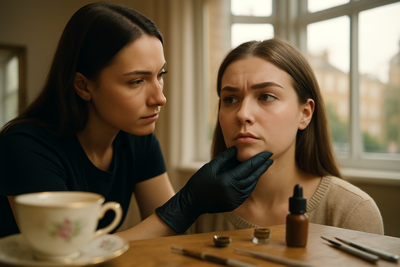
A thorough consultation is the most undervalued component of permanent makeup. Many Permanent Makeup Mistakes begin here: rushed consultations lead to mismatched expectations, poor colour choices, and incomplete medical histories. When consultation is treated as a box-ticking exercise, the result is often a complaint, a patch-up job or, worse, a medical complication.
In the UK context, clients expect transparency, clear information and time to make an informed decision. Set aside at least 20–30 minutes for a proper consultation for brows and similar sessions. Use that time to discuss style preferences, show healed before-and-after photos from your training or portfolio, and explain the realistic outcomes for their skin type. This helps reduce misunderstandings that often manifest as “mistakes”.
Practical tip: create a written consultation form that records expectations, references or photos the client brings, and a section where the client signs to confirm understanding of likely healed results. This small administrative habit reduces disputes and reinforces your professional process.
Consent, Medical History & Patch Testing
Missing or incomplete medical screening is a recurring cause of serious Permanent Makeup Mistakes. Clients often forget to disclose medications, autoimmune conditions, recent cosmetic procedures, or pregnancy. These factors can affect healing, pigment retention and the risk of adverse effects.
- Pros: Thorough screening reduces risk, improves outcomes and protects your legal position.
- Cons: Excessively long forms can overwhelm clients if not explained effectively.
Make screening collaborative rather than intrusive: explain why each question matters. For example, explain that blood-thinning medications, isotretinoin, or recent facial fillers can affect pigment uptake or cause bleeding. Where a potential contraindication exists, advise a GP consultation or defer treatment. In the UK, clients appreciate this cautious, safety-first approach.
Patch testing remains relevant where pigment allergies are possible. While true allergic reactions to modern PMU pigments are rare, sensitivity can occur. A simple patch test protocol — documented and photographed — is a low-cost safeguard and a strong professional practice to reduce avoidable complications.
Colour & Pigment Selection: Why It Goes Wrong
Colour choice is a technical skill and an artistic judgement. Permanent Makeup Mistakes like pigment turning blue, green or grey are usually the result of poor colour theory, inappropriate pigment selection for skin undertone, or inadequate understanding of how pigments age under skin chemistry. The keyword Permanent Makeup Mistakes often appears when inexperienced artists select pigments by brand name alone rather than by undertone and fade trajectory.
Start by assessing the client’s skin undertone (cool, neutral, warm) and hair colour. For example, cool undertones often suit ashier pigments, while warm undertones need neutral-to-warm pigments. Avoid using very dark black pigments for brows on lighter complexions — they can oxidise and appear blue-green as they fade.
Record the exact pigment batch, brand and shade in your client records and explain the expected healed colour. Showing controlled healed photos (week 4, week 8, month 6) helps set expectations and reduces the “I expected a different colour” complaints that often follow colour-related mistakes.
- Always account for post-inflammatory fading: pigments soften and lighten during the first 6–12 weeks.
- Mix conservative shades rather than pushing extremes — you can always darken or warm later in a top-up.
- Use neutralisers carefully: green/blue correctors work, but require experience and training.
- Document skin reactions and healing photos to build a personal reference library for different UK skin types.
Technique and Tool Errors
Technique-related Permanent Makeup Mistakes stem from fundamentals: incorrect needle depth, excessive pressure, wrong machine speed, or poor hand posture. Even highly trained practitioners can lapse under time pressure. Mastering machine settings and maintaining a gentle, consistent rhythm prevents trauma and patchy pigmentation.
- Needle depth too shallow = poor retention and patchy healing.
- Needle depth too deep = scabbing, excessive bleeding, and blurred strokes.
- High speed + high pressure = overworking the skin and scarring.
- Poor hand posture = inconsistent line work and client discomfort.
Use test strokes on practice skins and always calibrate your equipment before a session. Remember: we do not supply any Permanent Makeup equipment in the United Kingdom — part of professional training is learning to choose and maintain your own tools responsibly. For clarity, our online course focuses on technique, safety and decision-making skills to help you select appropriate equipment.
Practical habit: keep a simple checklist attached to your workstation that lists needle size, machine speed, pigment brand/lot, anaesthetic used, and client sensitivity notes. This reduces the number of “gotchas” that lead to avoidable mistakes.
Poor Shape, Symmetry & Mapping Mistakes
Some Permanent Makeup Mistakes are simply aesthetic: uneven brows, mismatched lip borders, or inconsistent eyeliner wings. These usually arise from rushed mapping or insufficient pre-drawing. The 2D face is dynamic — expressions, facial asymmetry and ageing all influence how a drawn design heals.
Always pre-draw and gain client approval while they are sitting upright and relaxed. Use multiple mirrors, photography from different angles and consider muscle activity — for example, smiling shifts brow and lip position. For brows, follow bone structure and natural hair patterns rather than forcing a trendy arch when it doesn’t suit the client’s face.
Make a habit of photographing the pre-draw in natural daylight. Digital records help if a client later claims their brows weren’t what they signed off. This step is simple but dramatically reduces disputes and is one of the most effective ways to avoid permanent makeup mistakes related to shape and proportion.
Aftercare Mistakes That Ruin Results
Even perfectly executed work can fail to heal well if aftercare is poor. Common aftercare-related Permanent Makeup Mistakes include clients exposing fresh work to sunlight, picking scabs, or using unsuitable creams that interfere with pigment healing. Clear, written aftercare instructions are essential.
- Explain the normal timeline for scabbing, colour loss and softening.
- Advise on sun avoidance and no direct chlorinated pool or sauna exposure for at least 2 weeks.
- Provide a short, clear do/don’t list — clients respond poorly to long, technical documents.
Use both verbal and written guidance and ask clients to confirm that they understand the instructions. Many complaints labelled as “mistakes” are in fact failures of communication on aftercare, so be clear and repeat major points before the client leaves your studio.
Where appropriate, provide follow-up contact (text/photo check-ins) during the first two weeks of healing. These short, friendly touches build trust, reduce worry, and allow you to spot early issues that could become permanent problems if left unaddressed.
Regulations, Hygiene & Record-Keeping
Hygiene failures are among the most serious Permanent Makeup Mistakes because they carry legal and health consequences. In the United Kingdom, local councils set premises standards for body art procedures; you must comply with your local authority’s rules on waste, sharps disposal, and hygiene. Maintain comprehensive client records and treatment logs — these are vital if a complaint or inspection arises.
Simple steps prevent most hygiene-related problems: single-use disposables where recommended, clear sharps containers, and documented cleaning protocols for non-disposable equipment. Training in blood-borne pathogen management and up-to-date first aid knowledge are non-negotiable for UK practitioners.
Quote: “Our local inspections focus on consistent record-keeping and clear infection control,” said a municipal environmental health spokesperson in an anonymised UK council statement. “Compliance reduces risk to both clients and operators.” Treat this as a partnership: practical compliance protects your licence and your reputation.
Full List: Top Permanent Makeup Mistakes
- Rushed consultation leading to mismatched expectations and dissatisfaction.
- Incomplete medical history and missed contraindications.
- Wrong pigment selection for undertone; pigments ageing poorly (blue/green casts).
- Incorrect needle depth and overworking causing scarring or blowouts.
- Poor mapping and symmetry errors causing uneven brows or lips.
- Inadequate aftercare advice leading to infection or pigment loss.
- Hygiene lapses: improper sterilisation and waste handling.
- Inadequate documentation (no photos, no consent forms).
- Failure to manage client expectations about multiple sessions and fading.
- Poor communication about pain, anaesthetic use and post-treatment restrictions.
This list captures the most frequent errors we encounter on review. Each item ties back to a fixable process. For instance, documentation prevents disputes, while better colour theory training reduces corrective tattoo referrals.
Many of these mistakes are preventable through structured workflows, continuous training, and adhering to clear safety and communication standards. That’s exactly what we teach in our Permanent Makeup course — we focus on avoiding these common traps so you start your practice with confidence.
Troubleshooting & Fixes for Common Errors
When something goes wrong, your response matters. Quick, professional handling builds trust and avoids escalation. Here are practical fixes for common issues:
- Uneven brows after healing: schedule a corrective top-up and use conservative density to rebalance symmetry.
- Pigment turning cool/blue: consider a neutralising pigment top-up; corrective colour theory is required — don’t guess.
- Infection signs: instruct the client to see a GP urgently, document communications, and pause further procedures until cleared.
- Client unhappy with shape: review pre-draw photos, explain healing changes, and offer a refinement session with a clear plan.
- Patchy retention: evaluate technique and skin type; schedule a conservative retouch and adapt needle depth/technique.
Document all interactions and keep a calm, solution-focused tone. A client who feels heard is far less likely to escalate a complaint, and many perceived mistakes can be corrected with a professional follow-up plan.
Training, Mentorship & Continuous Improvement
Many Permanent Makeup Mistakes are preventable through training and reflective practice. At Skinart United Kingdom we emphasise the complete workflow: client consultation, mapping, pigment selection, technical execution, hygiene and aftercare. Our online Permanent Makeup course covers these topics comprehensively with practical demonstrations, case studies and assessment.
Students will learn to identify risk factors, create robust consultation records, and use photographic documentation to inform future decisions. While we do not provide equipment in the United Kingdom, our curriculum prepares you to choose, calibrate and maintain your tools safely.
Quote from CPTP: “Ongoing education and practical mentoring are the best safeguards against avoidable mistakes,” says a recent CPTP advisory. Structured continuing education is widely acknowledged by UK councils and industry bodies as a marker of professional competence.
UK Examples & Success Stories
To make the advice tangible, here are anonymised examples from UK cases we reviewed during training and mentoring sessions. These real-world stories show how small changes in process prevented larger problems.
Case 1 — A client presented requesting a dramatic arch. After a 25-minute consultation, the trainee produced a natural brow mapping that respected the client’s bone structure. The client initially asked for a higher arch, but after seeing the pre-draw and hearing how ageing affects high arches, she chose the natural shape. Result: satisfied client and no corrective work required.
Case 2 — A trainee selected a dark cool pigment for a client with warm olive undertones. The pigment oxidised and appeared greener after six months. The fix required a neutralising top-up and a small colour-corrective session. The situation was avoidable with better undertone assessment and training that emphasises colour theory.
FAQs — Common Questions About Permanent Makeup Mistakes
Below are common search-style questions with concise answers. These address common concerns about mistakes and how to avoid them.
- What are the most common permanent makeup mistakes clients complain about?
Clients most often complain about colour mismatch, poor shape/symmetry, patchy retention and inadequate aftercare information; all of these are preventable with good consultation and clear documentation. - How can I avoid pigment turning blue or green?
Choose pigments matched to skin undertone, avoid overly black pigments on lighter skin, and maintain conservative colour choices; if you inherit older work, test and neutralise conservatively. - What should be included in a PMU consultation to prevent mistakes?
Include medical history, expectations, photographic records, mapping and signed consent; allow time for questions and ensure the client understands healing timelines and the need for top-ups. - Can poor aftercare cause permanent makeup to fail?
Yes — sun exposure, picking scabs, and using unsuitable creams can all disrupt pigment retention and cause uneven healing; clear written aftercare and follow-up reduces these risks. - When should I refer a complication to a medical professional?
If you see signs of spreading redness, fever, pus, or rapidly worsening pain, advise the client to see a GP immediately and document your guidance; infections are beyond cosmetic management and require medical care.
Final Thoughts — Turn Mistakes into Learning
Mistakes are inevitable in any skill-based discipline, but many Permanent Makeup Mistakes are avoidable. The difference between a novice and a confident, reliable practitioner lies in systems: robust consultations, strict hygiene, conservative colour choices, accurate documentation, and an ethical approach to client care. Investing time in these processes reduces risk and improves client satisfaction.
Skinart United Kingdom’s online Permanent Makeup course is tailored for those who want to fast-track their competence while avoiding the common errors described above. Our training focuses on transferable decision-making skills and practical protocols that protect clients and practitioners in UK settings.
Written by Gary Erskine — 25+ years in permanent makeup education and thousands of students trained — Skinart’s curriculum is built around real-world problems and tested solutions. When you learn the right process, it becomes easier to prevent, recognise and resolve the Permanent Makeup Mistakes that undermine confidence and careers.
Ready to Reduce Mistakes and Boost Confidence?
Join our accredited Online Permanent Makeup course and learn the practical systems and protocols that prevent the most common errors. Whether you’re new or refining your practice, our expert-led curriculum gives you the tools to deliver consistent, safe and beautiful results.
Recent Blog Posts
- Studio Etiquette Update: Professionalism in 2026
 Workplace Etiquette for Body Art Studios Refresh your studio etiquette and build a reputation for professionalism with these up-to-date best practices.… Read More »Studio Etiquette Update: Professionalism in 2026
 - 🌙 Eid Mubarak: Celebrate with 5% Off in 2026!
 Eid Savings: 5% Off All Courses Celebrate Eid with a special offer: 5% off any course. Use code EID5 at checkout.… Read More »🌙 Eid Mubarak: Celebrate with 5% Off in 2026!
 - Top Mistakes New Body Artists Should Avoid (2026)
 Stay Ahead: Common Pitfalls for New Artists Read up on the most frequent errors new body artists make, and how to… Read More »Top Mistakes New Body Artists Should Avoid (2026)