Piercing Courses for Beginners With No Experience
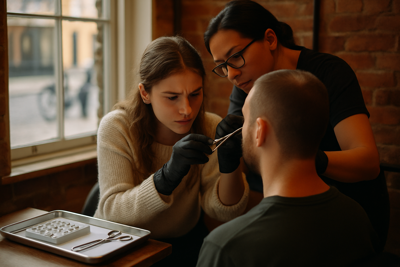
Starting a new creative career can feel like stepping into a different world. If you’re searching for “Piercing Courses for Beginners With No Experience” in the United Kingdom, you’re in the right place — Skinart United Kingdom specialises in fully accredited, beginner-friendly piercing courses that guide you from zero experience to confident, competent practice.
Whether you’re curious about professional ear, nose, or body piercing, or you’re considering a new career direction in the body-modification industry, our online piercing course is built for absolute beginners. This article explains what you will learn, how the course works in the UK context, common pitfalls to avoid, and why accreditation matters for your safety and future clients.
Written by Gary Erskine, 25+ years in body art education. All Skinart courses are accredited by the CPD Standards Office and the Body Art Qualification Association (BAQA), ensuring your training meets recognised UK standards.
Table of Contents
- Introduction: What beginners should know
- Why take a piercing course in the UK?
- Pros and cons of online piercing training
- Core skills you will learn
- Common mistakes beginners make
- Legal, hygiene and safety considerations in the UK
- Course format: what to expect from an online course
- Equipment, supplies and what we provide
- Frequently asked questions
- Final thoughts & next steps
Introduction: What beginners should know
Piercing Courses for Beginners With No Experience are designed to give learners a comprehensive foundation: anatomy, hygiene, technique and aftercare. If you live in the United Kingdom and want to become a professional piercer, a recognised course is your first step. At Skinart United Kingdom our online piercing course covers the essential theory and guided practicals tailored for beginners.
Beginners often worry about not having prior experience with needles, jewellery, or client communication. This is normal. The best training programmes break complex skills down into manageable steps, provide clear demonstrations, and emphasise safety and consent. We build your competence gradually so that each new skill sits on a solid base of knowledge.
From understanding different jewellery materials to mastering sterilisation and client consultation, an accredited course prepares you to work confidently and legally. Later in this article we’ll detail the exact modules you can expect and the typical progression timeline in our online piercing course.
Why take a piercing course in the UK?
Taking a formal course gives you the technical skills and the legal and hygiene knowledge required to work professionally. In the UK there are local authority regulations and public health expectations that piercers must meet. Accredited training from a reputable provider such as Skinart United Kingdom demonstrates you’ve completed robust learning and assessment in line with CPD Standards and BAQA guidelines.
- Accreditation helps you secure insurance and compliant premises.
- Structured learning reduces risk of infection and poor outcomes.
- Accredited certification is respected by employers and studio owners.
Beyond compliance, the course is about client safety, professional communication, and building the confidence to work with diverse anatomy and jewellery. Our emphasis is on hands-on competence supported by evidence-based aftercare guidance so your clients heal well and your reputation grows.
Many students in the UK use our course as the first step toward studio employment or to add piercing services to an existing body art or beauty business. Because the training is structured for beginners, you don’t need prior experience—just dedication and a willingness to learn.
Pros and cons of online piercing training
Online courses are an accessible way for beginners to learn the theory and approach practical skills in a controlled environment. Skinart’s online piercing course balances video demonstrations, guided assessments, and tutor feedback to develop safe, repeatable practice.
- Pros: Flexible learning schedule, accredited certificate, detailed video demonstrations, tutor feedback and UK-specific regulatory guidance.
- Cons: Online practicals require students to source their own kit for practice; we do not supply piercing equipment in the United Kingdom.
For many UK learners the flexibility is the deciding factor — you can study theory modules around work or family commitments. Practical competence is assessed through submitted work, photographs, and remote supervision, with clear performance standards.
We carefully describe how to practice safely at home and how to set up a compliant workspace for model practice. However, training that leads to professional practice requires conscious focus on hygiene, documentation and sometimes liaison with local council guidance.
Core skills you will learn
Our curriculum focuses on building a practical skill set that beginners can apply safely and professionally. The training starts with theory and moves methodically into practice, with multiple assessments and tutor-led feedback. “Piercing Courses for Beginners With No Experience” at Skinart cover the following key domains:
Technical competence, infection control, client consultation, record-keeping and aftercare are emphasised equally. You’ll learn to choose appropriate jewellery and gauge, assess anatomy, and apply atraumatic techniques for minimal tissue damage.
We also train students in professional conduct: gaining consent, managing complications, and when to refer to medical professionals. These soft skills protect your clients and your business reputation.
- Anatomy and tissue differences (lobes, cartilage, nostril, navel, etc.)
- Standard and advanced infection-control practices
- Sterilisation, single-use vs reusable instruments
- Jewellery materials and safe selection
- Marking, measurement and client positioning
- Technique for different types of piercing (cannula, needle, studs)
- Aftercare instructions and documentation
- Client consultation, consent forms and record-keeping
- Recognising complications and emergency action
- Professional ethics and business fundamentals for UK piercers
Common mistakes beginners make
- Skipping thorough client consultation or consent documentation
- Using unsuitable jewellery materials or incorrect gauge
- Poor marking, leading to asymmetry or misplaced piercings
- Inadequate hygiene or cross-contamination in the workspace
- Attempting advanced placements before mastering basics
- Over-reliance on anecdotal techniques instead of evidence-based practice
- Poor aftercare advice that increases risk of infection
- Rushing procedures and skipping checks for allergies or medical history
These common issues are the reason accredited training is so important. Our course concentrates on repeated practice of basic techniques and thorough training in consultation and aftercare to prevent these mistakes from becoming habits.
We also emphasise clinical judgement: knowing when a piercing is not suitable for a client, recognising signs of keloid or hypertrophic scarring, and understanding which presentations require medical referral. This protects both the client and your status as a professional.
Legal, hygiene and safety considerations in the United Kingdom
UK piercers must operate within local authority regulations which focus on infection control, premises standards and age restrictions. While legislation varies slightly by council, the core expectation is that practitioners maintain high standards of sterilisation and hygiene and obtain informed consent from clients. Skinart’s course covers UK-specific guidance so you can confidently meet local requirements.
Public health resources such as the NHS provide patient-facing guidance on piercing and aftercare; it’s useful to link clients to reliable information. For professional standards, accreditation with CPD and BAQA strengthens your compliance and signals to clients that you meet audited benchmarks.
- Understand local authority requirements for body art in your area.
- Maintain detailed client records, including consent and medical history.
- Use single-use sterile needles and appropriate disposables.
- Ensure waste disposal follows sharps and clinical-waste guidance.
- Follow clear aftercare instructions and support channels for clients.
Quote from a relevant authority: “Accredited training and strict hygiene practices protect both clients and practitioners. Local councils will expect practitioners to demonstrate competency and appropriate premises standards,” says a CPD Standards Office representative.
For client-facing guidance about safety and symptoms to watch for, the NHS provides an accessible resource: NHS — Piercing. That public guidance is useful to include in your client aftercare packs.
Course format: what to expect from an online course
Skinart United Kingdom’s online piercing course is structured to be learner-centred: clear modules, step-by-step videos, downloadable theory resources and practical assessments. As you progress you’ll submit work and receive tutor feedback from experienced professionals led by Gary Erskine.
Because we design the course for beginners, each module starts with a simple concept and builds to more complex techniques. We provide model-based practice scenarios and checklists so you can measure progress. The course culminates in a practical assessment and knowledge check tied to CPD and BAQA standards.
Please note: We do not offer in-person training for Piercing in the United Kingdom. All training and assessments are delivered online with remote tutor support. Students are responsible for sourcing practice equipment if they wish to rehearse practical techniques.
Equipment, supplies and what we provide
One common question is whether training providers supply equipment. For the United Kingdom, Skinart United Kingdom does not supply piercing equipment. Students are guided on what to buy, how to choose safe suppliers, and how to set up a sterile practice space for model practice. We recommend reputable UK suppliers and list the specifications you should follow (sterile, CE-marked where appropriate and from trusted vendors).
To help beginners get started, we provide checklists and supplier recommendations within the course materials. The lists explain what’s essential (single-use sterile needles, disposable gloves, antiseptics, dressing materials) and what’s optional for practice sessions. Always buy from recognised UK suppliers and check product certificates.
- Single-use sterile needles (various gauges)
- Sterile marking pens and measuring tools
- Disposable gloves and aprons
- Antiseptic solutions and sterile wipes
- Appropriate jewellery (implant-grade options for healing)
- Sharps disposal container and clinical waste handling kit
- Camera or smartphone for submission of practical assessments
- Client consent templates and record-keeping forms
We teach safe procurement and how to keep receipts and certificates for audit and insurance. Suppliers differ across the UK, so our materials include region-specific notes and advice on communicating with local councils and insurers.
How we assess your practical competence
Assessment is competency-based: you demonstrate knowledge and practical skills against clear criteria. Submissions include case studies, photographs of practice placements, written reflections and a final practical appraisal. Tutors provide constructive feedback, focusing on improvement and readiness for professional practice.
Embedded quote:
“Accredited, competency-led training helps ensure public safety and professional standards across the body-art sector.” — CPD Standards Office
Our tutors are experienced UK practitioners who assess work with an emphasis on clinical safety, documentation and client-centred service. The programme offers scaffolding and repeat opportunities to refine techniques until you reach required standards.
Success stories from United Kingdom students
We’ve trained many students across the UK who began with no experience and progressed to paid roles in studios or launched mobile services. One student from Manchester completed the online piercing course and was offered a junior piercer position in a respected studio within three months, thanks to strong practical submissions and good client communication shown in assessments.
Another graduate in Bristol added piercing to their beauty offering after completing the course, using the modules on client consultation, anatomy and aftercare to confidently expand services. These local examples show how accredited training can open doors when combined with careful practice and good record-keeping.
- Manchester: junior studio role secured after online assessment
- Bristol: added ear and navel piercings to a beauty business
- Edinburgh: freelance model practice leading to collaborations with tattoo studios
Frequently asked questions
Below are some common questions people searching for “Piercing Courses for Beginners With No Experience” often ask. Each answer is concise and practical for UK learners.
Can I take a piercing course with no prior experience?
Yes — accredited beginner courses are designed for students with no prior experience, covering theory and progressive practicals to build competence.
Will I be able to work in a UK studio after completing the course?
Completion of an accredited course is a strong foundation, but employers often look for evidence of practical competence and local compliance; some studios prefer additional supervised in-studio experience.
Does Skinart provide equipment for students in the UK?
No — Skinart United Kingdom does not supply piercing equipment. The course includes detailed guidance on what to purchase and how to source safe, reputable supplies within the UK.
Is the course accredited?
Yes — Skinart’s piercing course is accredited by the CPD Standards Office and aligned with BAQA recommendations, which helps with professional recognition and insurance applications.
How long does it take to complete the course?
The course is self-paced within the assessment windows and structured to let you work through modules as quickly as you can demonstrate competence; typical learners complete within weeks to a few months depending on practice time.
Final thoughts: Ready to begin?
Embarking on one of our Piercing Courses for Beginners With No Experience is a practical, accredited route into the body art industry. You’ll learn critical safety skills and practical techniques that studios and clients trust. Our approach is supportive and realistic, focusing on competence rather than shortcuts.
If you’re serious about learning in a way that’s both safe and recognised in the UK, your next step is to enrol. With tutor support from experienced practitioners and accreditation from CPD Standards Office and BAQA, your training will be understood and respected across the industry.
Take the first step today—your future clients deserve safe, skilled professionals, and you deserve training that helps you build a reliable career.
Recent Blog Posts
- Studio Etiquette Update: Professionalism in 2026
 Workplace Etiquette for Body Art Studios Refresh your studio etiquette and build a reputation for professionalism with these up-to-date best practices.… Read More »Studio Etiquette Update: Professionalism in 2026
 - 🌙 Eid Mubarak: Celebrate with 5% Off in 2026!
 Eid Savings: 5% Off All Courses Celebrate Eid with a special offer: 5% off any course. Use code EID5 at checkout.… Read More »🌙 Eid Mubarak: Celebrate with 5% Off in 2026!
 - Top Mistakes New Body Artists Should Avoid (2026)
 Stay Ahead: Common Pitfalls for New Artists Read up on the most frequent errors new body artists make, and how to… Read More »Top Mistakes New Body Artists Should Avoid (2026)