Real Student Journeys: Learning Piercing Online
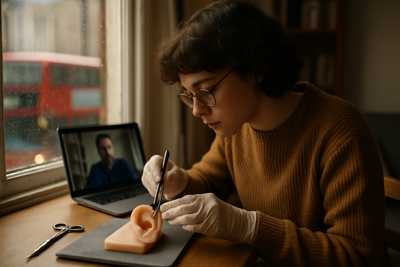
Learning Piercing Online has become a practical, flexible route for people across the United Kingdom who want to enter the body modification industry without pausing their lives. In this article we follow real student journeys — from first clicks through to confident client work — showing how an accredited online pathway can deliver safe, professional, and city-ready skills.
At Skinart United Kingdom we design our Piercing course to suit learners who need time flexibility but also expect high standards. Our online piercing training blends evidence-based theory, regulated assessment, and practical mentoring so students can develop competence and confidence on a realistic timetable.
Below you’ll read detailed accounts from students in London, Manchester and Glasgow, plus clear guidance about regulations, common mistakes to avoid, resources you’ll need in the UK, and how accreditation with CPD and BAQA supports your career. Whether you’re curious about switching careers or upgrading your studio practice, these journeys are practical, instructive, and rooted in UK practice.
Written by Gary Erskine, lead tutor — over 25 years training piercers and body artists.
Table of Contents
Use these anchor links to jump to the section you need. Search engines can use the IDs below to feature “Jump to” links in results.
- Why Learning Piercing Online Works
- Pros and Cons of an Online Piercing Route
- Common Learning Paths & What Students Do
- Common Mistakes New Piercers Make
- Equipment & Supplies in the United Kingdom
- Assessment, Accreditation and Certification
- Real Student Journeys (UK case studies)
- Frequently Asked Questions
- Final Thoughts & Next Steps
Why Learning Piercing Online Works
Learning Piercing Online is effective because it separates knowledge acquisition from practical application, allowing you to absorb infection-control theory, anatomy, client consultation skills, and UK-specific regulation at a measured pace. A quality online course provides structured modules that cover the science behind healing, the legal context in the United Kingdom, and the step-by-step protocols reputable studios use every day.
Online learning makes sense for people who already work shifts, have family commitments, or live beyond easy travel distance from training centres in cities like London or Manchester. With clear video demonstrations, downloadable checklists, and tutor feedback, students bridge the gap between the theory they study at home and the practical sessions they complete with a mentor or in a supervised practice setting.
Importantly, an accredited online piercing course — such as the Skinart Piercing Course — embeds assessment and record-keeping aligned with UK standards. This reduces risk and helps you present a credible portfolio to prospective employers and local councils when registering a studio or applying to work in an established site.
Pros and Cons of Learning Piercing Online
Choosing to study an online piercing course is a strategic decision that balances convenience against hands-on practice needs. Below is a concise breakdown to help you weigh the choice.
- Pros: Structured theory modules, flexible timing, access to recorded demonstrations, accreditation that supports UK studio registration and CPD points.
- Cons: Practical skills still need supervised practice; online courses require discipline and time management; equipment and consumables are not supplied by Skinart United Kingdom.
To expand: the online route is excellent for knowledge building and initial competence checks. However, piercing is a craft — the hand skills, palpation, and immediate client counselling benefit from close mentorship and supervised practice. We design our course to pair online theory with demonstrable practical outcomes, supported by tutor feedback and assessment criteria recognised by BAQA and the CPD Standards Office.
For UK students there is clarity around public health expectations, such as blood-borne pathogen precautions and waste disposal procedures; these are covered in depth so your knowledge meets local expectations even when you later transition to practical assessment in a supervised environment.
Common Learning Paths & What Students Do
Students who pursue Learning Piercing Online with Skinart United Kingdom typically follow one of three paths: career switchers, studio staff seeking formal qualification, or hobbyists moving to semi-professional practice. Each pathway has overlapping requirements but slightly different end goals.
Career switchers often start with the theory modules and schedule supervised practical sessions with a local mentor or through organised practical clinics. Studio staff use the course to formalise existing experience and gather recognized accreditation required by employers or local registration schemes.
Hobbyists or entrepreneurs focus on building a portfolio and learning client consultation and record-keeping to make sure they operate safely and in line with UK guidance. Across all groups the emphasis is the same: evidence-based practice, sound record-keeping, and demonstrable competence.
- Complete online modules covering anatomy, infection control, client communication, consent, and aftercare.
- Watch detailed procedure videos showing sterile set-up, marking techniques, and placement considerations.
- Submit written assessments and case studies to demonstrate theoretical understanding.
- Arrange supervised practical sessions — either with a local mentor or in an accredited practical clinic.
- Compile a portfolio of photographs, consent forms, and aftercare records for assessment.
- Complete online multiple-choice and short-answer exams to confirm knowledge retention.
- Receive tutor feedback and corrective guidance to refine technique and client interactions.
- Secure CPD/BAQA-aligned certification upon successful completion of theory and practical competence evidence.
Common Mistakes New Piercers Make
- Poor hand hygiene and inadequate glove technique (not changing gloves after touching non-sterile surfaces).
- Inadequate client consultation — failing to record medical history and contraindications properly.
- Incorrect placement — using aesthetic judgement without considering anatomy and tissue thickness.
- Over-tight or inappropriate jewellery selection leading to migration or rejection.
- Rushing procedures — skipping marking checks and second opinions for difficult placements.
- Poor aftercare advice — giving conflicting or unclear written instructions to clients.
- Insufficient documentation — incomplete consent forms, no photographic records, poor record-keeping.
- Using non-medical grade materials or unverified suppliers for consumables in the UK.
These mistakes are avoidable with the right foundation. Our online coursework emphasises why each error matters and provides checklists and assessment tools so students can self-audit before they submit practical evidence for assessment.
Through guided tutor feedback, students learn to build a consistent approach: mark, pause, check, and confirm before any piercing. That discipline significantly reduces complications and builds trust with clients and local authorities.
Equipment & Supplies for UK Students
When you’re Learning Piercing Online in the United Kingdom it’s essential to understand the equipment you will use, where to source it, and which items are non-negotiable from a safety perspective. Skinart United Kingdom does not supply piercing equipment. Students must source their own practice materials or work with a supervised mentor who can provide access to an accredited practical setting.
That said, the course provides an exhaustive list of recommended items and specifications, including the grade of jewellery, sterile needles, skin markers, antiseptics approved for clinical use in the UK, and clinical waste disposal guidance. We also explain how to vet suppliers so you avoid non-medical grade products and ensure traceability for audit and client safety.
Below is a compact checklist useful for UK-based learners preparing for supervised practical sessions. Use it to compare supplier specs and to discuss with your mentor before you practice on clients.
- Single-use, sterile, medical-grade piercing needles (appropriate gauges for the procedure).
- Implant-grade jewellery (titanium or 316L surgical steel meeting CE/UKCA markings where applicable).
- Alcohol-free antiseptics and chlorhexidine where recommended by UK health guidance.
- Disposable gloves (nitrile preferred) and glove-changing protocols.
- Skin markers and non-sterile disposables for pre-procedure marking (single use).
- Sharps containers and clinical waste bags compliant with local council collection rules.
- Aftercare information leaflets tailored to the piercing type and local UK language expectations.
- Clean, well-lit, and ventilated workspace or access to a mentor’s studio for supervised practice.
Assessment, Accreditation and Certification
Accreditation matters. Skinart’s online piercing course is aligned with the CPD Standards Office and the Body Art Qualification Association (BAQA), which means your certification is recognised across the industry and supports local studio registration or employment applications in the UK.
Assessment is completed through theory tests, submitted assignments, photographic evidence, and documented supervised practicals. Tutors provide formative feedback during the course and a final summative assessment confirms you meet the competence criteria required for certification.
- CPD-aligned modules with learning outcomes and assessment rubrics.
- BAQA recognition for national industry standards and quality assurance.
- Tutor-assessed practical evidence (photographs, consent forms, aftercare records).
- Multiple-choice and short-answer exams to verify knowledge across modules.
- Guidance on local council registration and what evidence you’ll need for inspections.
As part of our commitment to quality, students receive tutor-led commentary about any improvements required before final certification. This iterative process helps ensure the final qualification represents both knowledge and safe, repeatable practical skill.
Below is a short quote from an industry official emphasising the importance of accredited training:
“Accredited training provides clarity for both practitioners and local authorities — it raises standards and protects clients.” — Local Public Health Advisor, UK municipal health team
Real Student Journeys (United Kingdom Case Studies)
We’ve trained hundreds of piercers across the UK. These anonymised journeys reflect common experiences and useful takeaways for new students considering Learning Piercing Online.
Case Study — Emma (London): Emma worked full-time in hospitality and completed the online modules during evenings. She arranged three supervised practical sessions at a clinic in Shoreditch recommended by her tutor. Her assessor noted rapid improvement after targeted feedback on marking technique. Emma now works part-time in a well-known east London studio and uses her CPD-accredited certificate to meet local registration requirements.
Case Study — Tariq (Manchester): Tariq was a tattoo apprentice who wanted to add piercing to his services. The online coursework allowed him to study anatomy while continuing his tattoo shifts. Because the course emphasised documentation, Tariq presented clear client records and a professional portfolio which his studio owner used when applying for extended scope for the shop’s licence.
- Case Study — A student from Glasgow completed theory modules while working nights, arranged supervised practicals locally, and completed portfolio submission with strong aftercare records leading to a high pass with tutor commendation.
- Case Study — A freelance performer in Brighton used the course to formalise existing experience and won an independent studio contract after demonstrating safe sterile techniques and consistent client feedback records.
- Case Study — A community health worker in Birmingham chose the online route to gain recognised accreditation to better advise young people on safe modification choices.
- Case Study — A small-business owner used the Skinart course to set up compliant aftercare procedures and secure local council sign-off for a new pop-up studio in a seaside market town.
Across these journeys, three themes stand out: disciplined study of theory, purposeful supervised practicals, and thorough documentation. Students who combine those three elements tend to finish with confidence and a clear path into paid work.
Frequently Asked Questions
Can I learn piercing fully online and start working immediately?
While you can learn the theoretical foundations fully online, piercing requires practical supervised practice before you can responsibly begin working with clients. Our course provides the accredited theory, assessment criteria, and guidance to organise supervised practical experience — once you demonstrate competence, you can seek employment or supervised independent practice in the UK.
Is the Skinart online piercing certificate recognised in the UK?
Yes. Skinart United Kingdom’s piercing course aligns with the CPD Standards Office and BAQA, giving you industry-recognised accreditation that supports studio registration and employment applications across the UK.
Do you provide piercing equipment or starter kits in the UK?
No. Skinart United Kingdom does not supply piercing equipment. The course contains detailed supplier guidance and equipment specifications so you can source compliant, medical-grade materials locally or work with a supervising studio that provides the necessary items.
How long does the online piercing course take to complete?
The pace depends on your schedule. The course is modular and self-directed for theory, and students typically combine online study with scheduled supervised practical sessions. Discuss your timelines with a tutor to plan an effective pathway to certification.
Final Thoughts and How to Take the Next Step
Learning Piercing Online is a credible, efficient route into a rewarding career when paired with mindful practical training and strong record-keeping. Our students in the UK consistently report that the combination of detailed modules, clear assessment criteria, and tutor feedback made the transition into professional practice much smoother.
If you’re ready to learn the safe, compliant, and client-centred approach that employers and councils expect, the Skinart online Piercing course provides an accredited pathway tailored to the realities of working in the United Kingdom.
Take the next step: organise a short call with our admissions team or view the course outline to plan how the course will fit your life. We’ll help you identify the practical supervision options available locally and explain the assessment steps that lead to BAQA and CPD recognition.
Recent Blog Posts
- Studio Etiquette Update: Professionalism in 2026
 Workplace Etiquette for Body Art Studios Refresh your studio etiquette and build a reputation for professionalism with these up-to-date best practices.… Read More »Studio Etiquette Update: Professionalism in 2026
 - 🌙 Eid Mubarak: Celebrate with 5% Off in 2026!
 Eid Savings: 5% Off All Courses Celebrate Eid with a special offer: 5% off any course. Use code EID5 at checkout.… Read More »🌙 Eid Mubarak: Celebrate with 5% Off in 2026!
 - Top Mistakes New Body Artists Should Avoid (2026)
 Stay Ahead: Common Pitfalls for New Artists Read up on the most frequent errors new body artists make, and how to… Read More »Top Mistakes New Body Artists Should Avoid (2026)