What Is the Best Way to Learn Tattooing from Home?
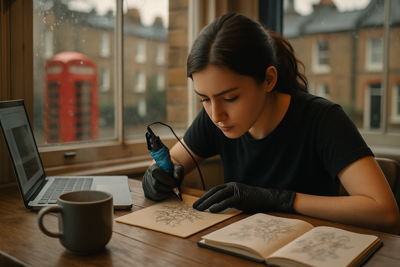
Want to Learn Tattooing from Home in the United Kingdom but not sure where to start? You’re in the right place. Whether you’re drawn to fine-line work, realism, illustrative pieces, or classic black-and-grey, learning to tattoo from home is realistic — if you follow a structured, accredited path designed around safety, practice and professional feedback.
This long-form guide walks through step-by-step how to build technical skill, understand the regulations, practise safely, and set up a sustainable learning plan. It’s written by Gary Erskine — lead tutor at Skinart United Kingdom with over 25 years in the industry — and reflects how thousands of our students have progressed from zero experience to accredited practitioners using online study and disciplined practice.
Throughout this article you’ll find practical lessons, checklists, common mistakes to avoid, and a clear pathway to accreditation. If you’re ready to learn tattooing from home with CPD-accredited training and BAQA-recognised standards, keep reading — and check the course at the end of the article.
Table of Contents
Jump to any section — we use semantic anchors so search engines can create “Jump to” results. Use these links to navigate quickly.
- Why Learn Tattooing from Home?
- Online Training vs Apprenticeship: Pros & Cons
- Practical Practice Methods to Build Skill
- Common Mistakes When Learning at Home
- Home Setup, Equipment & Safety
- A Learning Roadmap & Mentoring
- Skinart United Kingdom Online Tattoo Course
- FAQs — Learn Tattooing from Home
- Final Thoughts & Next Steps
Why Learn Tattooing from Home?
Learning tattooing from home has become a viable pathway for many aspiring artists in the United Kingdom. Advances in online education, high-quality video demonstrations, live mentoring and structured curricula mean you can build foundational knowledge, practice safely, and prepare for professional work without relocating or waiting years for an apprenticeship. Crucially, learning from home should be paired with accredited education so that your training meets national standards and legal requirements.
At Skinart United Kingdom we structure our online Tattoo course to cover both the creative and regulatory sides of the craft. That includes detailed modules on skin anatomy, infection prevention (including British public health expectations), client consultation, design transfer, tattoo techniques, aftercare, and business essentials. You’ll also receive critical feedback from experienced tutors to accelerate your learning curve.
Many successful UK artists started with self-directed learning at home before pairing that with live mentoring or studio shifts. The advantage of starting at home is focus: you control the pace, repeat complex lessons indefinitely, and work on drawing, shading, and machine handling in a low-pressure environment.
Online Training vs Apprenticeship: Pros & Cons
There’s no single “right” route to becoming a tattoo artist, but for many students in the UK, an accredited online course is an efficient, safe and cost-effective way to start.
- Pros: Structured curriculum, CPD and BAQA-aligned accreditation, flexible pacing, repeatable video lessons, remote tutor feedback.
- Cons: No physical apprenticeship hours by default, you must seek supervised studio time later to expand live client experience; equipment must be sourced independently in the UK market.
In the UK context, apprenticeships are valuable for on-the-job mentorship and real client flow, but they can be limited in availability and can take longer to access. An online route provides the knowledge base and practical exercises you need to be ready for a studio placement sooner.
Our recommended approach is blended: complete an accredited online course, build a disciplined portfolio at home, then arrange supervised sessions with a studio or mentor to convert practice into live client work. This two-step sequence reduces risk, improves safety outcomes, and shortens the overall timeline to competent practice.
Practical Practice Methods to Build Skill
Practising at home means breaking the craft into repeatable micro-skills. You want to move from pencil-and-paper drawing to machine control, shading drills, linework repetition and simulated skin work. Each stage should include clear success criteria before you progress.
Our curriculum emphasises graduated practice: start with traced linework, move to freehand designs, then shading gradients and finally composition sessions that mimic client pieces. Frequent, short practice sessions (30–60 minutes daily) beat long, infrequent marathons.
Below are proven at-home drills and exercises that students who Learn Tattooing from Home use to develop muscle memory, consistency and design sense.
- Linework drills on paper: straight lines, wavy lines, concentric curves.
- Stipple and dot gradients using fine liners before moving to needles.
- Practice on synthetic skins: outline, fill, and fade drills (choose high-quality practice skins available in the UK).
- Use tracing to learn proportions: trace a masterwork, then redraw freehand.
- Design composition exercises: crop, resize and adapt flash pieces for different body parts.
- Value and tone studies using pencil and ink to inform tattoo shading.
- Photography & portfolio building: photograph practice pieces in consistent lighting to document progress.
- Feedback loops: submit work for tutor critique and implement changes in the next session.
- Client consultation scripts: rehearse questions, consent phrasing and aftercare advice out loud.
Common Mistakes When Learning at Home
- Skipping foundational drawing practice and jumping straight to the machine.
- Ignoring hygiene modules or not following UK infection prevention standards.
- Using poor-quality practice skins or unreliable equipment sources.
- Not documenting progress with photographs — progress becomes invisible without records.
- Relying only on one source of feedback (e.g., social media likes) instead of tutor critique.
- Rushing sterile technique — contamination risk increases with shortcuts.
- Assuming online learning replaces live client experience — it prepares you, it doesn’t instantly certify you to tattoo clients without supervised practice.
- Failing to understand UK-specific regulations (consent, age limits, recordkeeping).
- Poor time management: irregular practice sessions slow skill acquisition.
Awareness of these common pitfalls helps you build a safer, more reliable path from novice to professional. A structured course will force you to complete hygiene modules and sign-off practical competencies before progressing — that checks many of these boxes for you.
When a student contacts us after making progress, they often say the contrast between ad-hoc practice and a curriculum-led program was the turning point. That’s why accreditation and tutor review matter so much for home learners.
Home Setup, Equipment & Safety
Setting up a safe home practice area requires discipline. You should dedicate a clean, ventilated workspace with a non-porous work surface, appropriate lighting, and a strict cleaning routine between sessions. While Skinart United Kingdom provides a complete learning pathway, we do not supply tattoo equipment in the United Kingdom — sourcing must be done through reputable UK suppliers.
Essential safety practices include sharps disposal, single-use needles, correct personal protective equipment (PPE), and a written checklist you follow before and after every practice session. The Health and Safety Executive (HSE) offers guidance relevant to sharps and waste management; complement your training with local council requirements before offering client services.
Below is a compact checklist to prepare your home workspace for practice and portfolio-building.
- Dedicated, uncluttered table with impermeable cover.
- Strong, adjustable lighting and magnification if needed.
- Disposable gloves, aprons, and clinically appropriate disinfectants.
- Sharps bin (colour-coded per UK guidance) and correct labelling.
- High-quality synthetic practice skins and a variety of needle configurations for drills.
- Camera or smartphone with tripod for consistent portfolio shots.
- Accredited first aid and blood-borne pathogen (BBP) training — required for many studios.
- Written logbook of practice sessions and tutor feedback entries.
A Learning Roadmap & Mentoring
To Learn Tattooing from Home effectively, treat your course like a mini apprenticeship: follow modules sequentially, complete practical sign-offs, and schedule regular tutor critiques. An effective roadmap includes:
1) Theory and hygiene modules (complete first). 2) Core machine technique and drawing fundamentals. 3) Progressive practical sign-offs on synthetic skins. 4) Portfolio development and simulated consultations. 5) Supervised studio time to transition to live clients. Each step should have clearly defined outcomes and evidence so a studio can verify your competency later.
- Week 1–4: Drawing fundamentals and hygiene theory — pass a quiz and BBP module.
- Month 2–3: Machine mechanics and linework — daily drills and weekly photo submissions.
- Month 3–6: Shading, gradation, colour theory and composition — submit progressive portfolios.
- Month 6+: Portfolio review, business modules (pricing, consent, recordkeeping) and studio placement planning.
Skinart United Kingdom pairs each student with tutors who provide structured video critiques and written assessments. This ensures the “home” element doesn’t become isolation — mentorship remains a central part of the training. When you are ready for supervised client work, tutors will advise on contacting studios and presenting your portfolio.
Skinart United Kingdom Online Tattoo Course
Skinart’s online Tattoo course is CPD Standards Office accredited and aligned with BAQA learning outcomes — designed for UK learners who want to Learn Tattooing from Home with a credible, recognised qualification. The course covers anatomy, infection prevention, client consultation, machine setup, needle selection, linework, shading, colour theory, aftercare, and business essentials tailored to UK market practice.
Written and taught by Gary Erskine (lead tutor, 25+ years’ industry experience), the course blends high-definition video lessons, downloadable resources, practical exercises, and one-to-one tutor feedback. Students submit progressive photo evidence and receive structured assessments to mark practical competencies.
Click the button below to view full course details, modules, and how to enrol.
Real UK Student Stories
We’ve trained students across the UK — from Glasgow to Bristol — who started at kitchen tables and progressed into reputable local studios. One student in Manchester used our portfolio method to secure a mentorship within 9 months; another in Cardiff turned a weekend market stall into a part-time client base after completing the course and following our client-consultation scripts.
These success stories show the common pattern: consistent, accredited learning + documented tutor feedback + deliberate outreach to studios led to real-world opportunities. The course prepares you to approach studios confidently with verifiable evidence of competency.
Remember: results depend on time invested, feedback acceptance, and a willingness to refine technique continuously.
Industry Voice & Official Guidance
To support learners, official organisations stress the importance of accredited training and infection control. The CPD Standards Office recognises the value of structured continuing professional development — and many studios look for CPD-aligned certificates when considering new trainees.
“Accredited learning helps standardise safety and competence in body art. For learners, it provides demonstrable evidence that best practice has been followed.” — CPD Standards Office
Local councils in the UK may have additional requirements for tattoo premises and waste handling. Before switching to live client work, check your local authority’s environmental health guidelines and the NHS guidance on tattoos and infection control: https://www.nhs.uk/conditions/tattoos/
FAQs — What People Ask When They Want to Learn Tattooing from Home
Below are answers to frequently asked questions we receive from UK learners. Each answer is concise to help you make a decision quickly.
- Can I learn tattooing from home in the UK?
- Is an online tattoo course recognised in the UK?
- Do I need to buy equipment from the course provider?
- How long does it take to become competent?
- Will an online course replace an apprenticeship?
Final Thoughts — Take the Next Step
Learning tattooing from home is a practical, modern pathway to a career in body art — provided it’s done with proper accreditation, tutor oversight and respect for UK safety standards. With careful practice, structured feedback and a plan to gain supervised client experience, you can build the skills studios value.
At Skinart United Kingdom we’ve helped thousands of students transition from curious beginners to trained practitioners. Gary Erskine and the teaching team bring real-world studio experience into every lesson so you learn techniques that transfer directly to client work.
If you’re ready to Learn Tattooing from Home and want a CPD-accredited, BAQA-aligned course with tutor feedback and a clear pathway to studio placement, click the button below to get started.
Ready to Start? Get Started Today
Join Skinart United Kingdom’s online Tattoo course — CPD-accredited and designed for learners who want to progress professionally. Written and tutored by Gary Erskine, this course gives you a clear, supported way to Learn Tattooing from Home.
Recent Blog Posts
- Studio Etiquette Update: Professionalism in 2026
 Workplace Etiquette for Body Art Studios Refresh your studio etiquette and build a reputation for professionalism with these up-to-date best practices.… Read More »Studio Etiquette Update: Professionalism in 2026
 - 🌙 Eid Mubarak: Celebrate with 5% Off in 2026!
 Eid Savings: 5% Off All Courses Celebrate Eid with a special offer: 5% off any course. Use code EID5 at checkout.… Read More »🌙 Eid Mubarak: Celebrate with 5% Off in 2026!
 - Top Mistakes New Body Artists Should Avoid (2026)
 Stay Ahead: Common Pitfalls for New Artists Read up on the most frequent errors new body artists make, and how to… Read More »Top Mistakes New Body Artists Should Avoid (2026)