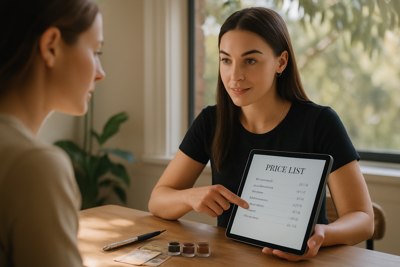
Pricing Your First Microblading Appointments

Starting out as a microblading artist in Australia can feel thrilling and daunting at the same time. One of the first decisions you’ll make that affects your income, reputation and bookings is how to set your price. This guide — focused on Pricing Your First Microblading Appointments — walks you through costs, models, psychology, and real-world examples to help you sell your time confidently.
Whether you trained online with Skinart Australia or you’re transitioning from beauty therapy, this article explains practical, Australia-specific steps to set prices that cover your costs, reflect your skill, and attract the right clients. We’ll also show how to structure packages, avoid common mistakes, and create an offering that grows with your experience.
Table of Contents
Use these links to jump to the sections below. Adding anchor-linked headings helps Google generate “Jump to” links in search results.
Sections
How to think about pricing your first microblading appointments
Pricing Your First Microblading Appointments begins with a mindset shift: you’re not selling a 60–90 minute appointment, you’re selling expertise, safety, and transformation. In Australia, clients expect high standards of hygiene and visible professional credentials. When you set prices, align them to the perceived value of those outcomes as well as the verifiable costs of delivering them.
In practical terms, think about three layers: direct costs (consumables, rental share), time (actual appointment time and client communications), and long-term investments (training, insurance, marketing). Multiply those layers into a base price, then adjust for local market conditions — inner-city Sydney will support different pricing than a regional town.
Remember: Pricing Your First Microblading Appointments is not set in stone. Your initial prices are experiments — track bookings, conversion rates, and client satisfaction and iterate every 6–12 months.
Breaking down your costs (essential math)
Before you name a number for Pricing Your First Microblading Appointments, tally every cost. The simplest formula is:
Base cost per appointment = (Consumables + Pro-rated equipment + Rent share + Insurance + Marketing contribution + Admin time) ÷ Expected monthly bookings
Here are the common line items to include. Be conservative — underestimating costs is the fastest route to burnout.
- Consumables: needles, numbing, pigments, barrier films, gloves, wipes — price every kit and multiply by waste factor.
- Equipment depreciation: microblading tools, lighting, magnifiers — amortise across useful life (e.g., 2–3 years).
- Station or studio rent: if you’re mobile or renting a room, include your hourly share of the space.
- Insurance and licences: professional indemnity, public liability and any local health registrations.
- Marketing costs: website, social ads, photography amortised across bookings.
- Admin time: consultations, messaging, pre- and post-care instructions, booking confirmations.
- Taxes: GST where applicable and set aside for end-of-year liabilities.
- Training and professional development: a percentage reserve you reinvest into courses and upgrades.
Example (brief): if consumables are $12 per client, rent share $30, insurance allocation $5, marketing $15, and amortised equipment $8, the direct cost is $70. Add your desired hourly rate (for example $60–$120 depending on locale and experience) and you’ll quickly see realistic price ranges.
Pricing models: which one suits you?
There are several common pricing models for microblading. Each has pros and cons depending on your goals, confidence and the market where you operate.
Pros and cons help you choose the right approach for Pricing Your First Microblading Appointments:
- Flat-rate per full-set (most common): A single price for initial microblading session (usually covering 90–120 minutes), with a separate touch-up fee.
- Tiered pricing (junior/senior): Lower price for less experienced artists; higher for senior artists. Good in multi-artist studios.
- Introductory offers: Discounts to build portfolio; often time-limited and with strict refund/consent rules.
- Value bundles: Combine treatment with aftercare products or a follow-up included to increase perceived value.
Follow-up thought: when you price an initial microblading appointment, clearly state what’s included (consultation, numbing, pigments used, aftercare, follow-up touch-up window). Clarity reduces disputes and supports your perceived professionalism.
In Australia, many seasoned microbladers start with a conservative price then increase as their portfolio, reviews, and waitlist grow. Protect your early reputation with excellent before/after photos and consistent aftercare messaging.
Designing appointment packages that sell
Packages make pricing simpler for clients and can increase average order value. For your first microblading appointments, consider these package ideas tuned for Australian clients.
Offer three clear tiers and make the differences obvious: what’s included, expected results, and any limitations.
- Standard Brow: One full microblading session + 6–10 week touch-up window (charged separately or bundled).
- Complete Brow Care: Full session + one complimentary touch-up within 8–12 weeks (higher price but perceived as “all-in”).
- Express Touch-up: For clients returning within 6–12 months for colour refresh — shorter time and lower price.
- Brow Sculpt & Colour Add-on: For clients who want shaping or tinting included alongside microblading.
- Student / Intro Offer: Small limited-time discount for first 10 bookings to build portfolio (use contract to manage expectations).
- Aftercare Kit Bundle: Include recommended products at retail price to increase revenue.
- Split Payment Options: Offer deposits and the ability to pay the remainder on the day to make higher-priced packages accessible.
- Gift Certificates & Vouchers: Great for special occasions and often bring new clients to your door.
When you show package pricing, always list the touch-up policy: whether it’s included, timeframe and any exclusions (scar tissue, skin conditions). This builds trust and reduces disagreement later.
In Australia, many clients will research safety and training credentials before booking. Display your Skinart Australia accreditation and CPD or BAQA recognition on package pages to reinforce value.
Common pricing mistakes and how to avoid them
- Underpricing to win clients (and then burning out)
- Not accounting for refunds, patch tests or no-shows
- Failing to include touch-up terms in writing
- Copying competitors without cost analysis
- Confusing discounting with long-term value
- Using inconsistent pricing across channels (website vs social)
- Not presenting what’s included — causing scope creep
- Ignoring local regulations and insurance requirements in pricing
Clients can tell when a price is arbitrary. When you avoid these mistakes you protect your business and ensure clients receive predictable care. For example, always require a non-refundable deposit to reduce no-shows and cover your basic kit costs.
Local example: a Skinart graduate in Melbourne began at AU$250 for an initial set, but after adding a clear touch-up policy and a refundable deposit she increased to AU$380 within a year due to fewer cancellations and better cashflow.
Marketing your price: explaining value clearly
Price is a story. When clients understand what they’re paying for — safety, pigment quality, experience, aftercare — they are more likely to book. Display case studies, before/after galleries, and testimonials that show outcomes, not just process.
Use simple messaging that answers the client’s top questions: How long will it last? What’s included? Is there a touch-up? Are you insured and accredited? Showing CPD Standards Office and BAQA accreditation reinforces trust; link to external pages where relevant so clients can verify standards.
- Use clear product pages with inclusions and exclusions
- Show a breakdown of the value (consultation, aftercare, touch-up)
- Use high-quality photos and short video testimonials
- List professional credentials and a short byline for credibility
- Offer an FAQ on pricing on the booking page to pre-qualify clients
- Encourage reviews and showcase them prominently
- Consider limited-time special offers to fill less-busy weekdays
- Use automated confirmation emails to reinforce value and reduce cancellations
Practical tip: price points ending in “9” (e.g., AU$389) often convert better than round numbers, but don’t let marketing tactics undercut profitability. Ensure your minimum price covers the base cost per appointment we covered earlier.
Handling deposits, cancellations and refunds
Clear payment policies reduce friction. For Pricing Your First Microblading Appointments, set these rules early and display them on booking pages and client intake forms.
Recommended approach:
- Require a non-refundable deposit (e.g., 20–30%) to secure the booking.
- Set a clear cancellation window (e.g., cancellations under 48 hours forfeit the deposit).
- Offer reschedules within a certain timeframe with minimal fee to be fair to clients.
- Be clear on circumstances for refunds (e.g., medical contraindications must be supported).
- Use a simple contract or online consent form with your terms sign-off prior to the appointment.
- Keep a documented trail of communications to avoid disputes.
- Consider offering a small credit for genuine emergencies rather than a full refund to preserve goodwill.
- Automate appointment reminders (48 hrs and 24 hrs) to significantly reduce no-shows.
Enforcing policies may feel uncomfortable initially, but consistent enforcement is what builds a professional practice and protects your time and finances.
Practical extras: checklists and local notes
To keep Pricing Your First Microblading Appointments consistent and safe, use checklists. Below are two helpful lists: client intake and in-salon setup. Use them every time to avoid hidden costs and to maintain standards.
Client intake checklist (essential items):
- Photo ID and contact details
- Medical history and contraindications (blood thinners, skin conditions)
- Allergy checks and patch tests if needed
- Clear explanation of expected healing and touch-up policy
- Consent form signed and stored
- Deposit or payment confirmed
- Pre-appointment instructions sent
- Aftercare instructions and product recommendations
Salon setup checklist (safety & cost control):
- Sterile workstation with barrier films
- Single-use needles and pigment pots
- Waste bin and sharps container
- Good lighting and comfortable client chair
- Aftercare product samples for retail
- Record keeping system for bookings and consent
Local note for Australian practitioners: keep up-to-date with any state or territory public health guidance relating to blood-borne pathogens; present your compliance clearly to clients when discussing price and care.
Industry perspective & quote
“Pricing should reflect safety, skill and consistent client outcomes. Accreditation and continuing professional development are a key part of building trust — and that trust allows you to charge fairly for your time.”
— CPD Standards Office (guidance summary)
We also quote a local training perspective: “Students who invest time in clear pricing, policies and professional presentation typically scale faster,” says Gary Erskine, lead tutor at Skinart Australia.
References: for general standards and continuing education guidance see the CPD Standards Office and the Australian Department of Health for infection control recommendations.
A local Australian success story
One Skinart Australia graduate in Brisbane launched with an initial price of AU$299 and carefully tracked all costs and client feedback. After six months she introduced a bundled aftercare kit and a strict deposit policy. Bookings grew and she raised her price to AU$450 while maintaining a high 4.9-star rating. The key drivers were clear policies, professional photos and transparent value communication.
Her approach demonstrates that Pricing Your First Microblading Appointments is iterative: test, gather evidence, and then refine. Use data — inquiries per week, conversion rate and repeat bookings — to support each price change.
If you’d like to create a similar plan, Skinart Australia offers an accredited Microblading course that covers the client management, legal and business side of the industry alongside technique training.
Frequently asked questions
Here are common questions people ask when they’re deciding how to price or book their first microblading appointment.
- How much should I charge for my first microblading appointments?
Set a price that covers your base cost per client plus a fair hourly wage. For many new Australian artists that starts between AU$250–AU$400 depending on city and included touch-up policy. - Should I include a touch-up in my first price?
Including one short touch-up within a defined window (e.g., 6–12 weeks) increases perceived value — you can bundle it or charge extra. Be explicit in writing. - How do I factor in no-shows?
Require a deposit to deter no-shows and allocate a small buffer into your pricing model for last-minute cancellations or repairs. - Can I change my price after I begin?
Yes. Communicate clearly: existing booked clients pay the price they agreed; new clients pay the updated price. Use your data to justify increases. - Where can I find more information about standards and training?
Look for accredited courses such as Skinart Australia and consult the CPD Standards Office and local health department guidance for safe practice.
Written by Gary Erskine, 25 years in microblading education and training. Skinart Australia — accredited with the CPD Standards Office and BAQA.
Gary has trained thousands of students globally and focuses on safe, sustainable business practices that help beginners earn fairly and grow their reputation.
Final thoughts: start confidently and iterate
Pricing Your First Microblading Appointments is a balance of cost coverage, market positioning and clear communication. Be methodical: calculate your costs, choose a simple pricing model, and present your packages in a way that emphasises results and safety.
Test small changes, record the outcome and learn from real client behaviour. Most successful artists in Australia adjusted prices 1–2 times in their first 12 months as their confidence, portfolio and client base grew.
If you’d like help building a pricing plan tailored to your area and goals, Skinart Australia’s accredited Microblading course includes business modules and ongoing tutor support to help you get bookings faster and price with confidence.