Permanent Makeup Certification & Insurance in Australia

Starting a career in Permanent Makeup (PMU) in Australia is exciting — but it also raises important questions about training, certification and insurance. Whether you’re planning to work from a studio, a salon or start mobile services, understanding Permanent Makeup Certification & Insurance in Australia is essential for your safety, your clients’ wellbeing, and your long-term business success.
This guide walks you through the practical steps to get accredited, meet Australian regulatory expectations, and secure the right insurance cover. It also explains how Skinart Australia’s fully accredited online Permanent Makeup course prepares you to meet industry standards and to apply for professional insurance with confidence.
Written by Gary Erskine, 25 years in Permanent Makeup education — this post draws on real Australian examples, regulatory guidance and practical tips so you can launch your PMU services the right way.
Table of Contents
Use the links below to jump to the section you need. We recommend bookmarking this page as a reference while you organise certification and insurance.
- What is PMU certification and why it matters
- Regulations & health requirements across Australia
- Insurance for PMU: types, pros & cons
- How to get certified with Skinart Australia
- Steps to secure professional insurance in Australia
- Common mistakes PMU practitioners make
- Equipment, supplies and what Skinart provides
- Record-keeping, consent & consumer rights
- FAQs
- Final thoughts & next steps
What is PMU certification and why it matters
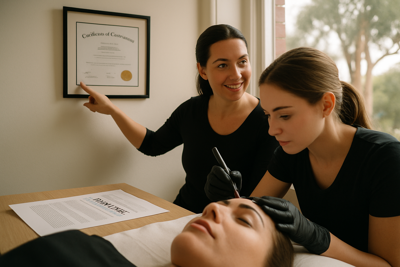
Permanent Makeup Certification is formal recognition that you have completed a structured training programme covering the theory and practical skills needed to deliver safe PMU services. In Australia, certification is increasingly expected by local councils, health regulators and insurance underwriters as evidence you can manage infection control, proper colour implantation and client aftercare.
Certification shows clients that you have followed accredited learning pathways, completed blood-borne pathogen training and have demonstrable practice in areas like skin anatomy, colour theory, needle technique and complication management. For many insurers, a recognised certificate is the baseline for offering public liability and professional indemnity cover.
When you invest in training that’s accredited — for example through CPD Standards or BAQA-recognised programmes — you reduce risk for everyone: your clients, your business and your insurer. This is why Skinart Australia emphasises accredited, evidence-based training as the first step to getting insured and operating confidently in Australia.
Regulations & health requirements across Australia
Australia does not have a single nationwide licensing scheme for PMU; regulation is largely driven by state and local council requirements. That means the exact steps to legally operate can differ between New South Wales, Victoria, Queensland, Western Australia and other jurisdictions.
- Pro: Local control means councils can adapt rules to community risk levels and public health needs.
- Con: Different rules between states mean you must check requirements for each location you work in.
To operate legally you will commonly need to meet minimum health and safety standards such as evidence of infection control training, completion of blood-borne virus modules, appropriate client consent forms and premises inspections when working from a studio. For mobile operators, councils often require a clearly documented infection control plan and risk assessment for each client visit.
Safe Work Australia and state health departments provide guidance on skin penetration procedures. It’s a smart move to check resources such as Safe Work Australia (https://www.safeworkaustralia.gov.au) and your local council’s public health pages to ensure you meet local expectations before offering services.
Insurance for PMU: types, pros & cons
Insurance for PMU practitioners is not optional if you want to protect your livelihood. Different policies cover different risks — the most common covers are public liability, professional indemnity and product liability. Some insurers will also offer business interruption and contents cover if you operate a studio.
Here’s a concise breakdown of common policy types and when they matter:
- Public liability insurance — covers compensation claims when a client or third party is injured or their property is damaged due to your business activities.
- Professional indemnity insurance — covers claims alleging negligence, poor advice or breach of professional duty (important for client dissatisfaction over results).
- Product liability insurance — relevant if you retail pigment products or equipment to clients.
- Business insurance — for studio contents, fixtures, equipment and business interruption risks.
- Clinical waste & sharps disposal cover — not a policy itself, but something insurers will check as evidence of safe practice.
- Mobile practitioner extensions — ensure your policy explicitly covers client visits to homes or other venues.
- Cyber insurance — increasingly useful if you hold client records and business systems online.
- Public liability aggregate limits and excess amounts — these shape the protection level and premiums, so review the schedule carefully.
Insurers will typically ask for evidence of training, a documented infection control policy, completion of blood-borne pathogen modules, and sometimes proof of membership to an industry body. Insurers prefer students who have completed accredited courses because they present a lower claims risk.
Costs vary across Australia depending on the level of cover, your turnover and whether you operate from a fixed studio or provide mobile services. Expect to budget for an annual premium and an excess per claim — plan this into your business model from day one.
How to get certified with Skinart Australia
Skinart Australia offers a fully accredited online Permanent Makeup course designed for professionals who want to meet Australian standards. The course covers core theory, infection control, pigment selection, colour theory and detailed practical guidance. While we do not provide in-person training in Australia, our online format is created to align with CPD Standards and BAQA expectations so graduates can meet insurer requirements.
- Accredited curriculum mapped to industry standards
- Comprehensive modules on health, safety and consent forms
- Assessment and evidence collection to demonstrate competency
- Support from experienced tutors including Gary Erskine
- Guidance on how to present your certification to insurers and councils
- Clear steps for submitting client records and photos as evidence of practice
- Access to templates for client consent, aftercare and record-keeping
- CPD and BAQA-aligned accreditation to strengthen insurance applications
Students complete theoretical modules and submit evidence of practical work as part of assessment. This is crucial when applying for insurance: insurers often request photos of healed work, documentation of practice hours and a certificate from an accredited provider. Skinart’s online PMU course supplies clear assessment criteria and templates you can include in your insurance application.
Because we don’t supply equipment or in-person training in Australia, students are responsible for sourcing their materials locally. Skinart gives you the knowledge and assessment framework; obtaining the right tools is your final step before practice. We provide guidance on what to buy, what to avoid and how to select reputable Australian suppliers.
Steps to secure professional insurance in Australia
Getting insured is a process — it’s not instantaneous. Below is a practical step-by-step plan to take the confusion out of applying for insurance as a PMU practitioner in Australia.
- Complete an accredited PMU course (evidence of training is usually required).
- Complete a recognised blood-borne virus/infection control unit and keep certificates.
- Prepare a portfolio of work: healed photos, before-and-after images and case notes.
- Compile client forms and templates: consent, medical screening, aftercare and incident log.
- Develop an infection control policy and sharps disposal plan suitable for your practice type.
- Get quotes from insurers who understand PMU or wider tattoo/skin-penetration industries.
- Confirm policy exclusions — ensure mobile work, teaching, or retailing pigments are covered if required.
- Once insured, display your policy certificate and insurer contact details in your studio and on professional materials where appropriate.
Tip: When comparing insurers, request sample policy wordings and enquire about claims examples. Insurers who specialise in beauty and skin penetration will better understand permanent makeup risks and are more likely to offer relevant cover.
At Skinart Australia we help students prepare the documentation insurers typically request, and advise on how to present your evidence to maximise acceptance. That support can make a real difference in an insurer’s assessment of your risk profile.
Common mistakes PMU practitioners make
- Starting work without an accredited certificate or training evidence
- Assuming a general business policy covers PMU — many do not include skin penetration
- Using non-Australian suppliers and failing to document product ingredients or sterility
- Insufficient client screening (missed medical conditions or contraindications)
- Poor record-keeping — no clear aftercare notes or incident logs
- Underinsuring — choosing low-limits that don’t cover serious claims
- Not checking policy exclusions for mobile services or teaching activities
- Failing to maintain CPR or first-aid certifications where required by local council
These mistakes can cost time and money, and in the worst cases, lead to cancelled policies or denied claims. Taking a methodical approach to documentation, training and insurance applications is the best prevention.
Quote from an industry public health officer: “When practitioners present clear, accredited training records and consistent infection control policies, councils and insurers are far more confident in approving operations.” — Municipal Public Health Officer, example city
Equipment, supplies and what Skinart provides
Skinart Australia’s course focuses on skills, assessment and documentation rather than the supply chain. We do not supply Permanent Makeup equipment in Australia. This approach is intentional — it keeps the course accessible and ensures students source equipment that meets Australian standards and local availability.
When sourcing equipment locally, prioritise:
- Devices and needles that meet medical-grade safety standards
- Pigments registered for cosmetic use and compliant with Australian chemical standards
- Single-use, sterile disposables (needles, pigment caps, gloves)
- Autoclaves or validated single-use systems for any reusable items
- Sharps containers and documented clinical waste disposal provider
- Cleanable work surfaces and appropriate personal protective equipment (PPE)
- Reliable photography setup for before/after and healed images
- Client record-keeping software or secure physical filing compliant with privacy laws
Skinart provides detailed supplier checklists, product evaluation guides and templates to help you create a purchasing plan that satisfies both regulatory expectations and insurer requirements. We also advise on how to keep purchase receipts and manufacturer statements — documentation insurers may request.
Local example: A graduate in Melbourne reported that carefully documenting pigment batch numbers, disposal invoices and infection control evidence helped their insurer reduce premium renewal increases the following year — small administrative tasks can yield big benefits.
Record-keeping, consent & consumer rights
Good record-keeping protects you and your clients. Standard records include client screening forms, signed consent, high-quality before/after photos, pigment batch numbers and a clear aftercare plan. These records help with client follow-up, manage adverse reactions, and form important evidence in the case of an insurance claim.
Consent forms should be explicit about the nature of PMU, expected healing outcomes, possible complications and follow-up procedures. Make sure clients understand the differences between immediate post-procedure results and long-term healed results, including the need for possible touch-ups.
Consumers in Australia are protected by the Australian Consumer Law (ACL). Transparency about pricing, realistic expectations and honest consent documentation reduces dispute risk — and insurers take a favourable view of practitioners who proactively manage client expectations.
Frequently Asked Questions
The following FAQs answer common searches about Permanent Makeup Certification & Insurance in Australia.
FAQ — Quick answers
Q: Do I need insurance to start? A: While not always legally required, professional insurance is strongly recommended and often required by landlords, salons and some councils.
Q: How much does PMU insurance cost in Australia? A: Premiums vary but typically range from a few hundred to over a thousand AUD annually depending on cover limits and practice type.
Q: Is online certification accepted by insurers? A: Many insurers accept accredited online certifications when accompanied by assessed practical evidence and infection control training.
Final thoughts & next steps
Becoming a confident, insured PMU practitioner in Australia is an achievable goal. Start with accredited training, document your practice carefully and engage insurers who understand the PMU space. Those steps protect your clients and safeguard the future of your business.
If you’re ready to take the next step, choose a course that provides clear assessment, industry-recognised accreditation and practical documentation support. Skinart Australia’s online Permanent Makeup course is built to do just that — helping thousands of students worldwide move from learner to insured practitioner.
We’re here to support you: from certification planning to preparing a professional insurance application, Skinart Australia helps you put best-practice evidence in front of councils and insurers so you can launch and grow with confidence.