Skip to content

SMP Machines and Pigments for Training

SMP Machines and Pigments for Training

Understanding SMP Machines and Pigments is the foundation of effective scalp micropigmentation training. Whether you are starting out in Australia or refining existing skills, knowing how machines interact with pigments, skin tone, and technique is critical to reliable outcomes and client satisfaction.

In this comprehensive guide from Skinart Australia, we’ll walk through the practical realities of selecting equipment, matching pigments to Australian skin tones, troubleshooting common issues, and how to structure your learning so you graduate with confidence. The content below is written to support students preparing for our accredited Scalp Micropigmentation course, and to help anyone in Australia make informed decisions about SMP machines and pigments for training.

Written by Gary, 23 years in SMP Machines and Pigments education — lead tutor at Skinart Australia with decades of hands-on experience and thousands of students trained worldwide.

Intro to SMP Machines and Pigments


At its heart, scalp micropigmentation is a precision craft that rests on two pillars: the device that deposits pigment and the pigments themselves. Understanding how SMP machines work — needle grouping, stroke depth control, speed, and tactile feedback — is just as important as understanding pigment formulation, opacity, and how colour shifts over time on different skin types.

When we train students in Australia on the Skinart Scalp Micropigmentation course, we emphasize an integrated approach: technique should be developed in lock-step with pigment selection and machine familiarity. This ensures outcomes that look natural and age predictably. In practice, a small change to machine speed or needle configuration can alter pigment scattering, density, and final visual texture.

SMP Machines and Pigments interact with skin in complex ways. Factors like scalp thickness, sebum levels, and previous hair density require the artist to adjust settings and pigment dilutions. Over the remainder of this article we’ll unpack each of these topics and give you practical guidance to apply during your training sessions.

Choosing the Right Machine — Pros & Cons


Not all SMP machines are created equal. When evaluating options for training, consider reliability, adjustable settings, ergonomics, and maintenance. A good training machine gives predictable stroke depth and consistent pigment delivery while allowing students to focus on hand technique rather than troubleshooting equipment failures.

  • Pros:
  • Consistent needle speed and depth adjustment options
  • Durable construction suitable for repeated student practice
  • Ease of cleaning and sterilisation between sessions
  • Ergonomic design to reduce fatigue during long practice sessions

Cons: Even the best machines have trade-offs. Some devices designed for heavy production can be noisy or heavy for smaller hands; others may be lightweight but lack fine adjustment settings. For training, avoid machines that have a steep maintenance curve or require niche parts that are hard to source in Australia.

Ultimately, the “best” machine for training is one that matches your teaching method and student skill level. In Skinart Australia’s online course, we teach technique and settings strategies that translate across most reputable coil and rotary-type SMP devices, focusing on principles rather than brand-specific quirks.

Pigments and Colour Theory for SMP


Pigments are as important as machines. A pigment’s carrier solution, particle size, and pigment base (organic vs inorganic) influence how it sits in the dermis and how it ages. Learning to mix and dilute pigments in training sets you up to match clients across the diversity of Australian skin tones.

Colour theory for SMP is practical: you are not creating a tattoo; you are simulating hair follicle shadows. That means focusing on undertone, contrast and how pigments fade under sun exposure and natural skin regeneration. Neutral undertones or warm-cool adjustments often deliver the most natural results.

When training, we ask students to perform controlled pigment tests on practice skins and to document how a pigment appears after multiple passes, when diluted, and when combined with other shades. Familiarity with a palette reduces mistakes and builds confidence when working on real scalps.

  • Universal neutral base pigments for initial matching
  • Warm/ash modifiers to correct excessive warmth or coolness
  • Dilution agents and the effects on saturation
  • Particle size and how it affects settling and dot crispness
  • Carrier solutions and potential allergy considerations
  • How UV exposure changes colour over time
  • Mixing protocols to achieve consistent shades across sessions
  • Record-keeping best practices for repeatable colour matches
  • Testing on synthetic skins and stepwise assessment routines

Common Training Mistakes with Machines & Pigments


  • Using incorrect needle depth for the scalp (too shallow or too deep)
  • Relying on a single pigment without testing blends or dilutions
  • Skipping patch and fade tests on practice skin
  • Poor documentation of settings and pigment mixes
  • Overworking an area, causing excessive scarring or blowout
  • Failing to adjust technique for oily vs dry scalps
  • Not accounting for sun-exposure-related fading
  • Neglecting strict hygiene between models during training
  • Learning on low-quality equipment that behaves unpredictably

These mistakes are common because students often focus on aesthetic results without first establishing methodical habits. In training we emphasise a protocol-driven approach: document machine settings, pigment lot numbers, dilution ratios, and the environmental conditions at time of treatment.

Addressing these common issues early prevents them from becoming ingrained. For example, establishing a simple pre-treatment checklist — machine warm-up, needle gauge and depth check, pigment swatches on practice skin — reduces the likelihood of overworking or mis-matching pigment. In Australia, where sun exposure can accelerate pigment change, we train students on aftercare advice to support pigment longevity.

Safety, Sterility and Pigment Compatibility


Safety in SMP training is non-negotiable. Choosing pigments that are sterile, traceable, and intended for scalp micropigmentation reduces infection and allergen risk. Always match pigments to reputable manufacturers with clear MSDS documentation and batch traceability.

Machines must be maintained and cleaned according to the manufacturer’s guidance. Even in training environments, single-use consumables for needles and barrier protection are standard best practice. In Australia we instruct students on local health regulations and cross-reference CPD and BAQA guidance to maintain compliance.

  • Always use single-use needles and appropriate barrier film
  • Only use pigments with clear MSDS and lot numbers
  • Document consent and allergy checks before every treatment
  • Follow correct disposal for sharps and contaminated materials
  • Maintain machine maintenance logs and sterilisation checklists
  • Test pigment compatibility with client undertone and sun exposure
  • Understand local public health requirements in your state
  • Use patch/testing procedures to reduce allergic reactions

Training Methods and Practice Strategies


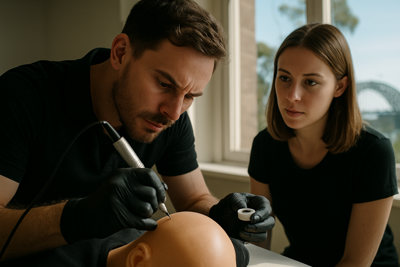
Practical training should combine theory, demonstration, supervised practice, and structured feedback. In our accredited Scalp Micropigmentation course we use progressive exercises: basic dot technique on synthetic skins, simulated sessions with variable skin types, and finally supervised client sessions (where applicable by location and regulation).

Focusing on machine settings and pigment behaviour during each drill helps solidify muscle memory while preventing bad habits. Students should keep a training logbook documenting setting changes, pigment choices, and outcome notes — this is an invaluable resource when translating classroom learning to paid work.

Peer review and recorded practice sessions accelerate learning. When you can review footage of your technique and compare with a documented setting/pigment choice, the correlation between action and result becomes clearer. Trainers should prioritise individualised feedback because small corrections in angle, pressure, or pacing make a significant difference.

“Proper training in machine handling and pigment matching is the difference between predictable results and guesswork.” — Gary, Lead Tutor, Skinart Australia

Equipment Availability in Australia — What to Know


Important note for Australian students: Skinart Australia provides accredited online training but we do not supply SMP equipment or pigments in Australia. That means students will need to source machines, needles, and pigments locally or through authorised Australian distributors. This approach ensures compliance with import rules, local regulations, and quicker access to replacement parts.

If you are sourcing equipment in Australia, prefer suppliers that can provide MSDS, batch numbers for pigments, and local warranties for machines. Reliable local support makes maintaining devices much easier and ensures you can service your machine as needed between practice sessions.

Many Australian cities — Sydney, Melbourne, Brisbane, and Perth — have suppliers specialising in micropigmentation consumables. Before you buy, check reviews and, where possible, request sample pigments for colour testing. Buying the wrong pigment type or an unsupported machine can add months to your learning curve.

Frequently Asked Questions


Below are common questions we hear from students preparing to train in SMP Machines and Pigments in Australia.

  • Q: What SMP machine should I buy for training?
    A: Start with a reputable rotary-style device that offers adjustable stroke length and RPM settings; choose one commonly used in the Australian market with local support.
  • Q: How do I choose pigments for different Australian skin tones?
    A: Use neutral base pigments and small warm/ash modifiers, always test on synthetic skins and document results before working on a live scalp.
  • Q: Are pigment allergies common?
    A: Allergic reactions are uncommon but possible; always perform a patch test and choose pigments with clear MSDS documentation.
  • Q: Will my machine settings in training apply to real clients?
    A: The principles transfer, but you’ll adapt settings for client-specific factors like scalp texture, oiliness, and skin laxity — that’s why supervised practice is essential.
  • Q: Can Skinart Australia provide equipment or pigments?
    A: No — we do not supply equipment in Australia. Students are responsible for sourcing machines and pigments locally from approved suppliers.

Final Thoughts — Take the Next Step


Mastering SMP Machines and Pigments is a journey that combines technical knowledge with repeated practice. In Australia’s diverse market, understanding machine behaviour and pigment interaction with skin is an asset that sets professional practitioners apart. Thoughtful preparation — testing, logging, and adapting — makes the difference between inconsistent results and work you can be proud of.

If you’re ready to learn in a structured, accredited format with experienced tutors, our Skinart Scalp Micropigmentation course is designed to give you the tools, feedback, and assessment you need. Our online course covers the essential principles for machines, pigments and clinical practice so you can start applying techniques safely and confidently.

Ready to start your SMP journey?


Recent Blog Posts