How to Combine Microblading with PMU Training

Combining microblading with PMU training is one of the smartest moves a brow technician in Australia can make today. Whether you already perform hand-tool microblading or are thinking about adding machine-based permanent makeup (PMU) to your skillset, this guide explains how to merge both approaches safely, legally and profitably. Throughout this article you’ll find practical direction, regulatory notes for Australian practitioners and real-world tips to help you plan the next stage of your training.
At Skinart Australia we believe in training that balances artistic technique with strict health and safety compliance. Written by Gary Erskine — lead tutor with over 25 years in body art education — this post draws on thousands of student outcomes, Australian examples and accredited curriculum standards to show how to Combine Microblading with PMU Training the right way.
If your goal is to widen services, improve clinical outcomes for clients and increase earning potential, combining microblading with PMU training offers a powerful pathway. Read on for a full roadmap that covers benefits, common mistakes, technical crossover, legal considerations in Australia and how Skinart Australia’s accredited Microblading course fits into your professional journey.
Table of Contents
- Why combine microblading with PMU training?
- Benefits and trade-offs
- Practical training pathway in Australia
- Common mistakes when combining microblading and PMU
- Technical differences and crossover skills
- Client management, consent and aftercare
- Regulation, accreditation and insurance in Australia
- FAQ — How to Combine Microblading with PMU Training
- Final thoughts and next steps
Why combine microblading with PMU training?
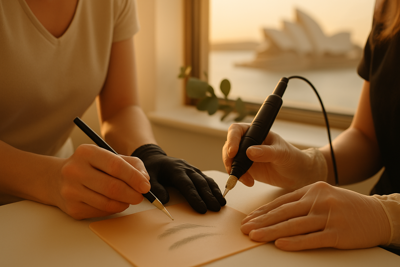
Microblading and PMU (machine-applied permanent makeup) are often seen as separate career tracks, but the reality is they are highly complementary. Microblading uses fine blades to deposit pigment in a hair-stroke pattern, delivering soft, natural brows for many clients. PMU includes machine tattooing techniques that allow for more varied effects — ombré shading, combo brows, lip blushing and correction work. Combining microblading with PMU training enables you to choose the best technique for each client’s skin type, lifestyle and desired outcome.
For Australian practitioners, combining these modalities boosts versatility and resilience. Skin types, climate exposure and cultural preferences across cities like Sydney, Melbourne and Perth mean a one-size-fits-all approach doesn’t work. When you know both microblading and PMU, you can offer microblading where crisp hair strokes are ideal and switch to machine techniques for skin that needs more saturation or longevity.
From a business perspective, diversifying services increases booking options, reduces cancellations due to unsuitable candidacy, and improves client retention. You’ll also find that clients who start with microblading may later request machine touch-ups or a combo approach; being trained in both eliminates the need to refer them away.
Benefits and trade-offs
Combining microblading with PMU training offers clear advantages, but there are trade-offs to consider before you commit to further education and retooling.
- Pros: Increased service range, higher average booking value, better outcomes for diverse skin types, greater professional credibility.
- Cons: Investment in additional training and equipment, need for thorough infection control updates, and a learning curve to master machine shading techniques.
The pros frequently outweigh the cons because the additional income potential and improved client satisfaction tend to pay back training costs quickly. For many Australian artists the biggest upfront challenge is updating their infection control procedures and ensuring their insurance covers both microblading and PMU work.
Skinart Australia’s accredited online microblading course is specifically designed to bridge the knowledge gap between hand-tool techniques and modern PMU approaches. While we do not supply physical microblading equipment in Australia, our training prepares you to select appropriate tools, integrate PMU methods and work confidently within local regulatory frameworks.
Practical training pathway in Australia
Australian regulations for cosmetic tattooing and microblading can vary by state and local council. The pragmatic way to approach combining microblading with PMU training is to create a staged learning plan that balances theory, supervised practice and accredited certification.
Stage 1: Start with a strong foundation in skin anatomy, colour theory, patch testing and infection control. These fundamentals apply to both microblading and PMU and are essential for meeting state health guidelines. Skinart Australia’s online microblading course covers these core topics with CPD and BAQA accreditation.
Stage 2: Learn hand-tool microblading techniques in-depth — stroke patterns, brow mapping and natural hair replication. Stage 3: Progress to machine PMU skills — needle configuration, machine settings, shading methods like ombré and microshading, and when to combine these with hair strokes for a combo brow.
- Complete accredited microblading theory and practical modules.
- Undertake supervised practice on practice skins and consenting models.
- Study machine-based PMU modules with an emphasis on shading and saturation.
- Update your infection control knowledge to Australian state requirements.
- Register for BAQA and CPD Standards Office accredited assessments where relevant.
- Review local council/health unit guidance for cosmetic tattoo premises and notifications.
- Obtain insurance that explicitly covers both microblading and machine PMU.
- Build a portfolio showing combined techniques and before/after images for different skin types.
Common mistakes when combining microblading and PMU
- Assuming microblading settings and machine settings are interchangeable.
- Using the same pigment shades for hand-tool strokes and machine shading without testing for interaction.
- Skipping formal infection control refreshers when adding machine work.
- Failing to update insurance to explicitly include PMU machine techniques.
- Ignoring skin type differences — oily or mature skin often needs machine methods for retention.
- Overworking strokes with a machine after microblading, causing excessive trauma and poor healing.
- Poor client consultation that doesn’t set realistic expectations for longevity and fading.
- Not creating a clear topical anesthetic and patch-test protocol when moving between techniques.
- Using incorrect needle configurations for shading vs. hairstrokes.
- Rushing learning: insufficient supervised model practice before charging full price.
Many of these mistakes come down to assumptions — assuming a skill in one method transfers instantly to another. That’s why a staged approach to Combine Microblading with PMU Training works best: learn muscle memory, then machine technique, then how to combine them without over-treating the skin.
In our experience, technicians who follow a structured curriculum reduce revisions, improve client satisfaction and lower complication rates. Accreditation through recognised bodies such as the CPD Standards Office and BAQA helps ensure your evidence demonstrates competency to regulators and insurers in Australia.
Technical differences and crossover skills
Understanding the core technical differences is crucial when you plan to Combine Microblading with PMU Training. Microblading is precise and superficial when performed correctly; machine PMU can deposit pigment deeper and with more saturation. That means subtle differences in hand pressure, angle and pigment dilution are necessary to avoid over-saturation or uneven healing.
Crossover skills include brow mapping, colour theory, an understanding of Fitzpatrick skin types, aftercare protocols and client communication. These shared competencies make it easier to learn the other discipline once your foundation is solid.
Below are practical technical pointers that help technicians switch safely between hand-tool microblading and machine PMU.
- Adjust pigment viscosity when switching from hand tool to machine — machines often need slightly thinner pigments for smoother flow.
- Use lighter initial passes with a machine on previously microbladed brows to avoid over-darkening.
- Carefully document stroke direction and depth during the initial microblading so any machine follow-up complements those strokes.
- Test patch heal times for each client; oily skin often fades microblading fastest and may need machine combo solutions.
- Learn appropriate needle groupings for microshading vs. hairstroke blending — they are not interchangeable.
- Plan staged treatments: an initial microblading session followed by a soft machine top-up at the touch-up can yield the most natural and long-lasting result.
- Keep a strict photo and consent record showing baseline, immediate post-treatment and healed results for each method.
- Be conservative with anesthesia when combining techniques; anaesthetic choice can affect healing and pigment retention.
Client management, consent and aftercare
Combining techniques raises important consent and client management considerations. When offering both microblading and PMU, your consultation must clarify which techniques are recommended and why — and outline likely healing trajectories and maintenance. Always include the phrase “Combine Microblading with PMU Training” in your internal training notes so each treatment plan reflects combined competency.
Provide clear written aftercare instructions tailored to the exact procedures performed. Microblading aftercare emphasises dry healing for the first week, whereas machine shading aftercare may include slightly different timelines for scabbing and moisturisation depending on technique and pigment saturation.
Good client management also involves scheduling realistic follow-ups. A common plan is initial microblading, a 6–8 week touch-up, then a 6–12 month shade refresh using machine techniques if needed. Communicate clearly about longevity, fade patterns and when corrective work is advisable.
“We advise practitioners to document each step and get explicit client consent whenever multiple techniques are used in a treatment plan.” — Local Health Unit (example guidance)
Regulation, accreditation and insurance in Australia
Regulatory oversight for cosmetic tattooing and microblading in Australia is largely managed at the state and local council level. Requirements may include notification of premises, infection control training, and specific disposal procedures for sharps and contaminated waste. Check with your local council and state Health Unit for exact notification requirements.
Accreditation through recognised bodies such as the CPD Standards Office and the Body Art Qualification Association (BAQA) is an important part of demonstrating professional standards. Skinart Australia’s microblading course is CPD and BAQA accredited, providing an evidence-based curriculum that meets contemporary Australian expectations for safety and competency.
Insurance is non-negotiable. When you Combine Microblading with PMU Training, confirm with your insurer that both hand-tool microblading and machine PMU are expressly covered. Many insurers will require proof of accredited training, infection control certification, and up-to-date First Aid and Bloodborne Pathogens (BBP) training.
FAQ — How to Combine Microblading with PMU Training
Below are answers to common questions Australian technicians ask when considering combined training.
Can I learn PMU after completing a microblading course?
Yes. Completing a solid microblading course provides a strong foundation in brow mapping, colour theory and client care that translates well to machine-based PMU training; however, you will still need specific instruction on machine settings, needle groupings and shading techniques to be competent with PMU.
Do I need different insurance for PMU compared to microblading?
Most insurers treat microblading and PMU as related but distinct services. When you Combine Microblading with PMU Training, confirm coverage explicitly for both modalities and provide details of accredited training and infection control certification to your insurer.
How long before I can safely offer combo brows to clients?
After accredited training, supervised practice and successful healing outcomes on several models, many technicians begin offering combo brows. A recommended minimum is documented practice on at least 10–15 live models, with close mentoring or assessment for your first paying clients.
Are there additional regulatory steps in Australia if I add PMU?
Regulation varies by state and council. You may need to update your business notification, infection control paperwork, and sharps disposal procedures. Always check with your local council and state health authority for exact requirements before offering new services.
Final thoughts and next steps
Combining microblading with PMU training is not just about adding a new technique — it’s about growing as a clinician and offering better outcomes for a broader range of clients. The ability to choose hand-tool hair strokes, machine shading or a combination tailored to an individual’s skin and preferences sets top-tier technicians apart.
If you’re based in Australia and want to expand your services responsibly, start with accredited education, supervised practice and clear updates to your infection control and insurance documentation. Skinart Australia’s accredited microblading course gives a robust foundation and is designed to fit into the staged learning plan described above.
Take the next step today: plan your learning pathway, update your compliance, and build a portfolio showing combined techniques. With the right training and mentorship, combining microblading with PMU training becomes a strategic advantage that benefits clients and your career.
Ready to combine microblading with PMU training?
If you’re in Australia and want accredited, practical training tailored to brow artists, Skinart Australia’s online microblading course is a perfect starting point. Our curriculum prepares you to make informed decisions about when to use microblading, when to move to machine PMU, and how to combine techniques for best results.