Pricing Microblading Appointments: Costs, Time and Package Inclusions
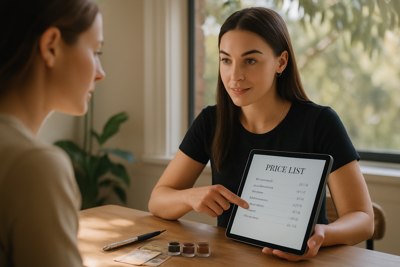
A useful starting price comes from a defined service and a realistic cost calculation. Separate what each client costs from your monthly overheads, include the time outside the appointment and state what the client receives. This guide provides a planning worksheet, not an Australian market rate or a promise of earnings.
Define What One Sale Includes
Choose the unit you are pricing before doing the maths: one appointment, or a package with more than one visit. List consultation time, treatment time, setup and cleanup, messages and any included follow-up work.
If a follow-up is included, count its time and supplies in the package cost. Do not calculate the cost of the first appointment and describe the result as the cost of the entire package.
Write a short description of the offer. For example: “The quoted package includes [named services and visits]. Additional services are quoted separately.” Fill this in from your actual arrangements; the example does not prescribe a treatment schedule.
Separate Three Types of Cost
- Direct cost per sale: consumables and other items used for the defined appointment or package. Use supplier costs and realistic quantities.
- Working time per sale: all hours associated with that offer, multiplied by the hourly amount you include in your plan for that work.
- Allocated overhead per sale: relevant monthly business costs divided by a realistic number of completed paid sales for the month.
For this planning method: cost per sale = direct costs + working-time allowance + allocated overhead. Divide the monthly overhead by monthly sales; do not divide per-client consumables by monthly sales again.
Avoid double-counting. If the labour for a task is already included in your working-time allowance, do not also add it as an identical monthly cost. For mixed services, use an allocation that reflects their different use of time and resources.
The Australian Government’s pricing-strategy guide explains why total costs and the chosen pricing approach belong together.
Work Through a Labelled Example
The following numbers are invented solely to demonstrate the calculation. They are not recommended microblading prices, typical appointment times or reported Skinart student results. All figures use a consistent basis excluding GST; tax and payment-fee effects are not included.
| Planning item | Example |
|---|---|
| Direct costs per package | $35 |
| Total working time | 3 hours × $40 = $120 |
| Monthly overhead allocation | $600 ÷ 20 packages = $30 |
| Planning cost per package | $35 + $120 + $30 = $185 |
At a hypothetical price of $250 on the same tax basis, the difference is $65 before payment fees, tax and any omitted costs or reserves. It is not a guaranteed take-home profit.
Now change only the volume assumption. At 10 packages, the overhead allocation becomes $60 and the planning cost becomes $215. The same $250 price then leaves $35 before those further adjustments. This shows why a full appointment book should not be assumed in a starting budget.
Check Fees and Package Boundaries
Add actual payment-processing costs using the provider’s terms. A percentage fee changes with the amount charged, so test it against the proposed selling price rather than treating it as a fixed supply cost.
Distinguish a deposit credited toward the agreed total from an additional fee. Do not count the deposit and the full appointment price as separate sales revenue when they pay for the same service.
- Which visits and services are included?
- Are any products included or optional?
- What additional work requires a separate quote?
- How are booking changes and payment terms explained?
Keep the booking page, written quote and confirmation consistent. Avoid claiming savings unless the comparison reflects an actual like-for-like offer.
Compare the Market Without Copying a Price
Record the scope of each public offer you compare: location, included visits, practitioner experience presented, products and other stated inclusions. An advertised price is not evidence of how much the business earns or how many clients it sees.
Use those observations alongside your own costs. If the price you are considering does not cover your plan, revisit the scope, costs or assumptions before advertising. Do not reduce essential preparation or appropriate service standards to make the arithmetic fit.
Check the ACCC’s price-display guidance when presenting consumer prices, including mandatory charges. Keep tax treatment consistent in your working figures and confirm how it applies to your business before publishing prices.
Review Actual Results and Update the Worksheet
- Record the agreed price and what was delivered.
- Record actual working time, supplies and payment fees.
- Compare completed paid sales with your volume assumption.
- Separate refunds, discounts and unpaid bookings from collected revenue.
- Review the difference between the planned cost and the actual cost.
Change an assumption when the records show it was wrong. A higher advertised price is not automatically an improvement if the offer, costs and completed bookings have also changed.
If you are still preparing to offer microblading, keep pricing work alongside your training and operating checks. Read the microblading licensing and insurance guide and review the current course curriculum before deciding what further preparation you need.
Course Details and Next Steps
Review the current course details for Australia and contact Skinart with questions about your selected option. Existing students can return to their lessons in the academy.