Top Permanent Makeup Mistakes and How to Avoid Them
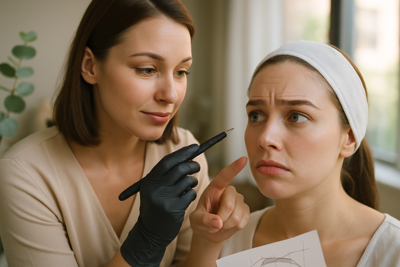
Permanent Makeup Mistakes can be costly — to a client’s confidence, a technician’s reputation, and sometimes to their health. In Australia, where professional standards and client expectations are high, recognising common pitfalls and knowing how to avoid them is essential for every technician, whether you’re just starting or have years of experience behind you.
This in-depth guide walks through the most frequent errors we see in permanent makeup practice — from poor colour choices and rushed consultations to aftercare mismanagement and inadequate infection-control processes. Each section not only explains what goes wrong, but gives clear, practical steps you can apply immediately to improve outcomes and reduce complications.
Whether you’re a student considering enrolment or a seasoned practitioner looking to sharpen your technique, Skinart Australia’s PMU training is designed to address these issues head-on. The tips below reflect lessons learned over decades of teaching and thousands of procedures supervised by Gary Erskine and our training team.
Table of Contents
Use these links to jump to the section you need. Anchor-linked headings with semantic IDs also help Google generate “Jump to” search results.
- Why Permanent Makeup Mistakes Matter
- Consultation & Communication Errors
- Tools, Needles & Infection Control
- Colour, Skin Tone & Undertones
- Technique and Application Errors
- Aftercare and Healing Mistakes
- Training, Accreditation & Legal Risks
- Top 12 Permanent Makeup Mistakes
- FAQs
- Final Thoughts & Next Steps
Why Permanent Makeup Mistakes Matter (and What’s at Stake)
Poor permanent makeup outcomes affect more than appearance. They touch on client safety, emotional wellbeing and legal liability. A badly matched brow shade, uneven lip liner, or infection after a procedure can lead to painful remediation, costly corrective work, and damaged trust. That’s why understanding the common Permanent Makeup Mistakes and their prevention is fundamental for Australian practitioners.
From a business perspective, one unsatisfactory result spreads quickly in local communities and on social media. For clients, reversals or touch-ups may not always restore their original confidence. The more you minimise mistakes, the stronger your reputation, the fewer corrective sessions you need to perform, and the happier your clients remain.
At Skinart Australia we emphasise a systems approach: assessment, technique, documentation, and aftercare. Each stage reduces risks. This section introduces the core concepts you’ll see expanded later: accurate consultation, sterile technique, correct colour science, patient-centred aftercare, and ongoing training.
Consultation & Communication Errors
A thorough consultation is the first defence against Permanent Makeup Mistakes. Missed medical history, inadequate expectation management, or failing to confirm a client’s daily makeup habits can all lead to poor results. Effective consultation identifies contraindications (allergies, active skin conditions, medications), aligns expectations and documents agreed outcomes.
- Pros: Builds client trust, reduces legal risk, improves healed results.
- Cons: Takes time up front; requires disciplined forms and clear scripts.
In Australia, it’s good practice to use a written consent form, photographic records and a checklist that captures medications (including isotretinoin, anticoagulants), recent cosmetic procedures and any history of keloid scarring. Ask about recent sunburn, chemical peels, or laser therapy, and always note Fitzpatrick skin type and known pigment tendencies.
Use clear visual aids during consultation: pre-draw brows, show colour swatches on the client’s skin, and photograph the mapped result. This reduces misunderstandings and helps when explaining realistic outcomes, particularly for clients who expect dramatic instant change.
Tools, Needles & Infection Control: Small Details, Big Consequences
Using the wrong needle configuration, poor device maintenance, or lax sterilisation are frequent contributors to poor outcomes and post-procedure infection. In Australia, clinics are expected to meet strict infection control protocols — even for mobile practitioners — and clients reasonably expect sterile, single-use consumables where required.
While Skinart Australia does not supply PMU equipment within Australia, our course teaches how to select and inspect machines, power supplies, needles and pigments. We emphasise single-use items for needles and strict aseptic technique for surfaces and client prep.
Common mistakes include reusing multi-use items when single-use is required, failing to properly document batch numbers and pigment expiry, and incorrect disposal of sharps. These are avoidable with process checklists, training and a culture of safety.
- Not verifying sterility or expiry of pigments
- Using inappropriate needle depth or configuration
- Poor machine maintenance causing inconsistent stroke depth
- Incorrect glove changes during procedure
- Failing to pre-clean client skin or remove makeup properly
- Poor sharps disposal practices
- No written infection control policy or manufacturer instructions ignored
- Failure to document instrument serials, pigment batches and client charting
Colour Selection, Skin Tone & Undertones
Choosing the wrong pigment or ignoring the client’s undertone frequently creates undesirable healed results. Colours may oxidise, migrate or fade to different hues depending on skin chemistry. This is one of the most common Permanent Makeup Mistakes and a major reason why many clients request correction work.
Good colour science requires understanding warm vs cool undertones, the effect of sun exposure and melanin level, and how pigments behave in a variety of Fitzpatrick skin types. Always patch test where there’s any doubt and document the chosen formula. In Australia’s diverse population, expect to see every skin tone — your palette and technique must be equally adaptable.
Skinart Australia teaches practical colour-matching techniques and offers case studies from local clients across NSW, Victoria and Queensland. A mistake we emphasise avoiding: selecting a pigment by sample swatch alone without seeing how it heals after two weeks.
- Failing to assess undertone (warm/cool/neutral)
- Using dark pigments for initial laydown causing heavy healed look
- Ignoring sun damage and epidermal changes
- Not testing pigments on similar skin tone prior to full application
- Over-saturating an area in a single session
- Mismatching liner colours for lips vs natural lip tone
- Choosing pigments with poor manufacturer documentation
- Assuming pigment behaviour is identical across different machine settings
Technique and Application Errors
Technique is where artistry meets science. Common application mistakes include inconsistent needle depth, uneven stroke pressure, and poor hand speed — all of which affect pigment retention and healed aesthetics. These are avoidable with practice, good ergonomic setup, and consistent machine tuning.
One recurrent error is attempting to deliver a finished look in a single session. Conservative layering and planned touch-ups often provide superior, natural results. Another is overworking the skin during a single pass, which increases trauma and scarring risk.
Address technique problems with methodical practice: stabilise your hand, map strokes precisely, and standardise machine settings for particular pigments and skin types. Video recording your sessions (with client consent) is an excellent way to review and refine technique.
- Inconsistent needle depth across the treatment area
- Unsteady hand leading to uneven strokes
- Overworking the skin (too many passes)
- Wrong machine speed or voltage settings
- Poor client positioning and practitioner ergonomics
- Rushing through the mapping process
- Lack of a staged approach (laydown vs shaping passes)
- Failing to adapt technique for sensitive or scarred tissue
Aftercare and Healing Missteps
Aftercare is a critical stage where practitioner guidance and client compliance converge. Mistakes here include vague instructions, recommending inappropriate products, or failing to advise on sun protection and swimming pools. These errors can cause pigment loss, colour shifts, infection or extended healing times.
Provide clear, written aftercare instructions tailored to the procedure and to seasonal considerations in Australia — for example, extra sun protection in summer and cautious exposure after beach holidays. Recommend only suitable topical products and explain signs of infection or allergic reaction and when to contact you.
Follow-up is equally important. Schedule a 4–8 week review to assess healing, discuss any touch-ups and document the healed colour and saturation. This protects you and supports better long-term results.
- Not providing written aftercare instructions
- Recommending heavy creams or petroleum-based products that impede healing
- Missing to warn against exercise and sweating for the first 48–72 hours
- Failing to advise on swimming pools, spas and ocean exposure
- No clear instructions about scab management (don’t pick!)
- Not scheduling a follow-up to assess healing
- Ignoring seasonal sun exposure and its effects on pigments
- Not informing clients about realistic fading and maintenance plans
Training, Accreditation & Legal Considerations
Insufficient training is a root cause of many Permanent Makeup Mistakes. Accredited education minimises risk and improves outcomes. Skinart Australia’s online Permanent Makeup course is CPD Standards Office and BAQA accredited and focuses on both practical technique and professional responsibilities. The course material emphasises local Australian regulatory expectations and best practice for infection control and documentation.
Regulators and local councils may require specific registration, business licenses or health approvals for permanent makeup services. Practitioners should check with their state or territory health department for guidance. For blood-borne virus control and sharps handling, Safe Work Australia or local public health bodies are authoritative references.
To add credibility and reduce legal risk, maintain detailed client records, implement a documented infection control policy and carry appropriate public liability and professional indemnity insurance. Ongoing refresher training and supervised practice are strong defences against skill fade and liability.
- Failing to complete accredited training before practicing
- Not renewing relevant certifications (e.g., first aid or BBP awareness)
- Missing required business registrations or local council approvals
- Inadequate record-keeping and consent documentation
- No professional indemnity or public liability insurance
- Ignoring manufacturer instructions for pigments and devices
- Skipping supervised practice or mentorship
- Not keeping up with changes in regulation or standards
Top 12 Permanent Makeup Mistakes (and How to Avoid Each)
Below is a practical checklist of the most common errors that crop up in training and clinics. For each, we give a short avoidance strategy you can adopt immediately.
- Skipping a detailed consultation — Avoidance: implement standardized intake forms and mapping photos.
- Poor pigment selection — Avoidance: learn colour theory, test on similar skin types, and document formulas.
- Inconsistent needle depth — Avoidance: practice on synthetic skins, use depth stops and steady your hand with anchors.
- Overworking tissue — Avoidance: plan staged sessions; stop when the skin reacts.
- Using expired or unverified pigments — Avoidance: log batch numbers and check manufacturer data.
- Failing to follow infection-control protocols — Avoidance: keep a checklist and audit your workspace regularly.
- Rushing the mapping phase — Avoidance: pre-draw and confirm with client under natural light.
- Inadequate aftercare instructions — Avoidance: provide written, step-by-step guidance and a follow-up appointment.
- No contingency plan for adverse events — Avoidance: have a clear escalation and referral list (GP, dermatologist) and emergency contacts.
- Poor documentation — Avoidance: photograph pre, intra and post-procedure; store records securely.
- Ignoring client lifestyle factors (e.g., tanning, swimming) — Avoidance: ask and explain how these affect healing and pigments.
- Insufficient ongoing education — Avoidance: commit to CPD, mentorship and peer review to refine technique.
Addressing these 12 areas will dramatically reduce the most common Permanent Makeup Mistakes. They form the core of what we teach in the Skinart Australia online PMU course, with curriculum mapped to CPD and BAQA standards so you can operate confidently in an Australian context.
Real-world example: a Melbourne student in our course avoided a costly colour mismatch by applying the colour-testing protocol taught on Module 3. The client healed with natural-looking brows and later referred two friends — a small change in process led directly to business growth.
Client Consultation Best Practices & Quotes from Experts
Good consultation habits are emphasised by industry bodies for a reason. Here are a couple of authoritative lines to remember.
“Clear, documented consent and a thorough medical intake are essential components of safe cosmetic tattooing.” — CPTP (Cosmetic Tattooing Professional Panel) statement.
And a local perspective from an Australian council public health officer: “Practitioners must operate within local health requirements, maintain records and ensure safe clinical environments.” These practical reminders underline why we prioritise documentation and infection control in our training.
- Use scripted consultation prompts to avoid missing crucial questions.
- Photograph pre-draws to confirm client direction and protect your practice.
- Keep a referral list for dermatology and GP follow-ups when medical complexity arises.
A Local Australian Example: Avoiding a Colour Disaster
In a Sydney case study used in our live feedback sessions, a technician initially selected a cool-toned brown for a client with warm, olive undertones. The healed result looked ashy and unnatural — a classic Permanent Makeup Mistake. The technician followed our colour-correction protocol and used a warm corrective pigment in a staged session, with much better client satisfaction.
This example highlights simple prevention: match undertones, consider staged layering, and always inform clients of the potential for a corrective session. The client became a positive referrer after the correction — and the technician learned a process change that removed future errors.
Skinart Australia includes multiple local anecdotes like this so students can see how technique and decision-making must adapt to Australia’s varied skin tones and climates.
FAQs — Top Permanent Makeup Mistakes and How to Avoid Them
The following questions are phrased as clients and new technicians commonly search for answers. Short, actionable responses help clarify next steps.
What are the most common Permanent Makeup Mistakes beginners make?
Beginners frequently under-consult, choose the wrong pigment or needle, and overwork the skin. Proper training, a standardized consultation and supervised practice reduce these errors substantially.
How can I avoid colour mismatch in permanent eyebrows?
Assess undertones, test pigments on similar skin patches, and stage the pigment application. Avoid laying down overly dark pigment in a single session as it often heals cooler or lighter.
What should I include in aftercare to prevent complications?
Provide clear written instructions covering cleansing, scab care, avoiding pools and sun exposure, signs of infection, and when to return for follow-up. Schedule a review 4–8 weeks after treatment.
Are infections common after PMU in Australia and how to avoid them?
Infections are uncommon when correct infection-control protocols are followed. Use single-use needles, clean surfaces, change gloves appropriately, and document sterilisation and disposals.
Do I need accredited training before offering PMU services in Australia?
While regulatory requirements vary, accredited training (such as CPD and BAQA-aligned courses) provides essential skills and reduces the risk of Permanent Makeup Mistakes. It also strengthens client confidence and business credibility.
Final Thoughts — Become a Confident, Competent PMU Professional
Permanent Makeup Mistakes are often procedural rather than intentional: they result from gaps in training, rushed workflows, or missed steps. The good news is that they’re preventable. With structured consultation, correct pigment science, attention to sterile technique, and practical aftercare guidance, you can dramatically reduce complications and build a thriving practice.
At Skinart Australia our online Permanent Makeup course is tailored to Australian practitioners. It covers the essential techniques and the business and safety frameworks you need. The course is CPD Standards Office and BAQA accredited, taught by Gary Erskine — who has trained thousands of students across 25+ years in the industry.
If you’re committed to raising your standard of care and avoiding the most common Permanent Makeup Mistakes, this course will give you structured learning, practical tips and actionable checklists you can implement straight away.
Ready to Minimise Permanent Makeup Mistakes? Get Started Today
If you want practical training, clear protocols and CPD-aligned accreditation, Skinart Australia’s online Permanent Makeup course is designed for practitioners operating across the country. Our lessons are presented by Gary Erskine, who brings over 25 years of hands-on experience and thousands of supervised student procedures.
Written by Gary Erskine, 25+ years in Permanent Makeup education. Gary has trained thousands of students internationally and focuses on practical, safe, and compliant techniques that reduce the incidence of Permanent Makeup Mistakes.
Recent Blog Posts
- 🌙 Eid Mubarak: Celebrate with 5% Off in 2026!
 Eid Savings: 5% Off All Courses Celebrate Eid with a special offer: 5% off any course. Use code EID5 at checkout.… Read More »🌙 Eid Mubarak: Celebrate with 5% Off in 2026!
 - Top Mistakes New Body Artists Should Avoid (2026)
 Stay Ahead: Common Pitfalls for New Artists Read up on the most frequent errors new body artists make, and how to… Read More »Top Mistakes New Body Artists Should Avoid (2026)
 - Client Communication Skills: 2026 Body Art Success
 Master Consultation for Better Results Top communication strategies for client satisfaction and better outcomes in 2026 and beyond. X Send Chat