Skip to content

Do You Need a License for Tattoo Removal in Australia?

Do You Need a License for Tattoo Removal in Australia?

The question “License for Tattoo Removal in Australia” comes up for many artists, clinic owners and entrepreneurs planning to offer tattoo removal services. With an evolving regulatory landscape across states and territories, and new methods such as ink‑rejection removal gaining traction, it’s essential to understand what counts as lawful practice and what qualifications or approvals you should hold.

In this guide from Skinart Australia we break down what licensing means in practice, how state and local council rules differ, what training you should complete to stay safe and legal, and how our accredited online Tattoo Removal course can make sure you meet the right standards. Whether you’re evaluating options for a clinic in Melbourne, Brisbane or Perth, this article will help you make an informed, practical decision.

What “License for Tattoo Removal in Australia” means


When people ask about a “License for Tattoo Removal in Australia” they’re often trying to clarify two related but distinct things: statutory licences or approvals required by state health departments or councils, and the formal training or accredited qualifications that demonstrate competence. In practice, compliance usually means meeting local council requirements for premises and infection control, plus holding appropriate accredited training and insurance.

There is no single national “tattoo removal license” that covers every state; instead, frameworks differ between NSW, Victoria, Queensland, and the other jurisdictions. For many practitioners the most important legal obligations are clinic registration, local council approvals for skin penetration services, and following safe‑practice standards such as infection control and waste disposal.

At Skinart Australia we teach accredited methods that align with the CPD Standards Office and BAQA expectations so graduates can demonstrate documented competence when applying for council approvals, insurance, or when responding to client and regulator queries.

Do you need a license to perform tattoo removal?


Short answer: It depends on where you practise and on the method you use. Many local councils treat tattoo removal as a skin penetration or cosmetic service and require clinic registration and adherence to infection control requirements. Some jurisdictions also require practitioners to hold an accredited qualification or documented evidence of training.

  • Pros:
  • Professional credibility when you can show accredited training and CPD
  • Easier to obtain public liability and professional indemnity insurance
  • Compliance with council conditions reduces the risk of fines or closure

On the other hand, if you misunderstand the rules or assume licences are the same across Australia you can run into problems. Below are the key considerations when evaluating whether you need to apply for a specific licence or just meet training and premises requirements.

First, check with your local council for any skin penetration or cosmetic procedures code. Second, confirm that your chosen training provider is recognised by the CPD Standards Office and that your certificate or statement of attainment maps to the competencies the council expects.

State & territory requirements — a practical guide


Regulation is primarily state and territory‑based. Below are the practical starting points for each jurisdiction. This is a general guide — your local council may have additional conditions or development rules.

We include examples from real councils and common expectations so you know what documents to prepare when applying for approvals.

Remember: the focus keyword “License for Tattoo Removal in Australia” applies differently across these areas — sometimes it’s a licence, sometimes it’s a requirement to hold accredited training, and sometimes it’s ensuring premises compliance.

  • New South Wales (NSW) — Many councils treat tattoo removal as a skin penetration service. Expect to supply a copy of your certificate, infection control plan, and insurer details. Check with NSW Health and your local council.
  • Victoria (VIC) — Councils may require registration for skin penetration businesses and adherence to “Safe Sharps and Infection Control” guidance. Accredited training is strongly recommended to obtain insurance.
  • Queensland (QLD) — Several regional councils require businesses to be registered and premises to meet specific cleaning and waste standards. Proof of training and BBP awareness is commonly requested.
  • Western Australia (WA) — Council public health teams set the rules; some areas require premises approval and documented procedures for aftercare and infection control.
  • South Australia (SA) — Local councils regulate skin penetration; you’ll usually need to demonstrate practitioner competence and a documented cleaning/waste plan.
  • Tasmania (TAS) — Smaller councils may have bespoke rules; a clear training certificate and documented protocols help smooth approval.
  • Australian Capital Territory (ACT) — The ACT has tighter health oversight in some clinics; ensure you can show accredited training to satisfy registration queries.
  • Northern Territory (NT) — Check with local health authorities and council; documentation and infection control plans are typically expected.

Common mistakes practitioners make (and how to avoid them)


  • Assuming a single national licence covers all states
  • Not checking local council codes for skin penetration or cosmetics
  • Using the wrong terminology on applications (e.g., calling ink‑rejection removal “cosmetic tattooing” without clarifying the method)
  • Failing to document infection control procedures and client aftercare
  • Relying solely on informal mentoring instead of accredited training
  • Operating without appropriate public liability and professional indemnity insurance
  • Not keeping records of consent, contraindications or treatment plans
  • Assuming laser removal rules automatically apply to ink‑rejection methods

These mistakes are common because the field is evolving quickly. Councils and insurers often treat tattoo removal differently from tattooing or cosmetic tattooing. Our advice: prepare clear, written documents that describe the exact method you will use (for us, that’s the ink‑rejection tattoo removal method), provide evidence of accredited training, and be ready to demonstrate infection control and record-keeping.

If you are unsure what your council expects, speak with a council environmental health officer or the local public health unit. They can usually explain whether you need premises registration, what documentation to provide, and what inspection standards will apply.

Training, accreditation and CPD: what councils and insurers want


Most councils and insurers will look for evidence that you have completed a reputable course that covers infection control, client assessment, aftercare, and the technical procedure. For tattoo removal, the emphasis is on safe skin penetration practices, wound management and understanding contraindications.

Skinart Australia’s accredited Tattoo Removal course aligns with CPD Standards Office and BAQA requirements so you can present a robust paper trail when applying for approvals or insurance. Our training focuses on the ink‑rejection method — a specialist approach taught with clinical safety at its core.

  • CPD and BAQA-aligned certificate of completion
  • Modules on infection control, BBP awareness and aftercare
  • Clinical documentation templates to help with council applications
  • Practical modules covering client assessment and contraindications
  • Guidance on setting up clinic protocols for waste, sterilisation and sharps
  • Business-ready consent forms and treatment records
  • Support for preparing evidence for insurers and regulators
  • Access to tutors for clinical queries during the course

Holding a relevant accredited certificate significantly improves your standing with insurers and environmental health officers. It’s not just about satisfying regulators — it’s about running a safer, professional practice that attracts clients and reduces clinical risk.

How the ink‑rejection tattoo removal method changes the conversation


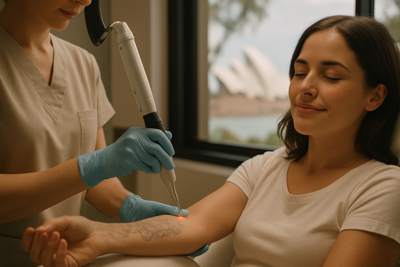
Unlike laser removal, the ink‑rejection method we teach involves implanting a specialist removal solution into the skin to encourage the body to expel tattoo pigment. The technique targets multiple colours, typically requires fewer sessions than many lasers, and aims to reduce scarring when performed correctly.

Because the method is procedural and skin‑penetrating, regulatory expectations often align it with other skin‑penetration services. That means councils will want to see accredited training, infection control plans, and clear clinical protocols.

At Skinart Australia we emphasise documentation and consent. Clients need to understand realistic outcomes, aftercare and potential complications. Clear, well-documented training helps satisfy regulators — and keeps your clients safer.

“Practitioners should always provide clear documentation of training, clinical protocols, and infection control measures when offering tattoo removal services.” — CPD Standards Office (guidance to training providers and practitioners)

Setting up safely — insurance, records and clinic requirements


Even where a specific licence isn’t required, operating without insurance or adequate records exposes you to financial and legal risk. Insurers will ask for proof of training in the relevant removal method, client consent templates, and evidence of clinic hygiene systems. Many insurers now require CPD or an accredited qualification to issue cover for tattoo removal services.

Keep thorough records for every client: pre-screening, consent, treatment notes, photos and aftercare instructions. Councils and health inspectors expect good record keeping; it also protects you if a client raises concerns later.

Two practical recommendations:

  • Obtain public liability and professional indemnity insurance that explicitly covers tattoo removal and the ink‑rejection method.
  • Prepare an infection control manual and a waste‑disposal plan (sharps containers, clinical waste contractors, cleaning schedules) to present to your local council.

Frequently asked questions


Below are commonly searched questions about “Do You Need a License for Tattoo Removal in Australia?” with concise answers to help you quickly find the key facts.

Q: Do I need to contact my local council? — Yes, contact your local council’s environmental health or public health unit to confirm premises registration, inspection schedules and any fee structure.

Q: Is Skinart Australia recognised for accreditation? — Skinart Australia provides CPD Standards Office and BAQA‑aligned training. Our certificate packages include the clinical documentation councils commonly request.

Final thoughts — making the right start in Australia


Understanding whether you need a “License for Tattoo Removal in Australia” is about more than paperwork — it’s about managing risk for your clients and protecting your business. The best first step is to document your method, complete accredited training that matches council expectations, and prepare the clinical and hygiene protocols councils look for.

Skinart Australia offers an accredited online Tattoo Removal course designed to give you the knowledge, clinical documentation, and CPD evidence needed when engaging with local councils, insurers and clients. Our course focuses on the ink‑rejection method and is taught by tutors with decades of industry experience.

Take a responsible, informed approach: check local requirements, complete accredited training, and put strong clinic systems in place. If you want clear, accredited training that helps you present a professional application to councils and insurers, we’re here to help.

Start your accredited Tattoo Removal training today


Get recognised training that helps you meet council, insurer and client expectations. Our online Tattoo Removal course is fully accredited and taught by industry professionals with decades of experience.

Recent Blog Posts

Written by Gary Erskine, 25+ years in body art education. Gary is the lead tutor at Skinart Australia and has trained thousands of students worldwide in safe, accredited tattoo and tattoo removal practice.

Skinart Australia is an internationally recognised provider of body art training. All our courses are accredited with the CPD Standards Office and the Body Art Qualification Association (BAQA).