Feedback is most useful when it changes what you do next. A broad comment such as “work on consistency” needs to become something you can observe in practice.
Repeat the feedback in your own words and ask whether you have understood it correctly. Request an example of the feature being discussed. Separate the part you understand from anything that still needs explanation.
Agree one focused exercise with your trainer and keep its conditions consistent enough to compare results. Record the purpose before starting. Avoid trying to address every comment at once if that makes it impossible to tell what changed.
Turn “your lines need confidence” into a review question
For a fictional drawing review, “more confidence” could refer to hesitation, repeated sketch strokes, unclear hierarchy or something else. Ask the reviewer to point to one example and explain the visible feature. A better question is: “On this paper study, do you mean the repeated outline around the leaf, or the difference between the main outline and the interior detail?”
The answer determines the exercise. A study of line hierarchy is different from a study of continuous drawing marks. Keep this discussion on the approved training medium and follow the trainer’s practical instructions. Do not infer machine settings or a method for working on skin from a comment about a photographed drawing.
Keep this checklist
- Quote the feedback accurately
- Identify the exact feature
- Agree an exercise within the course
- Collect a comparable example
- Return with the original question
Turn one comment into a drawing exercise
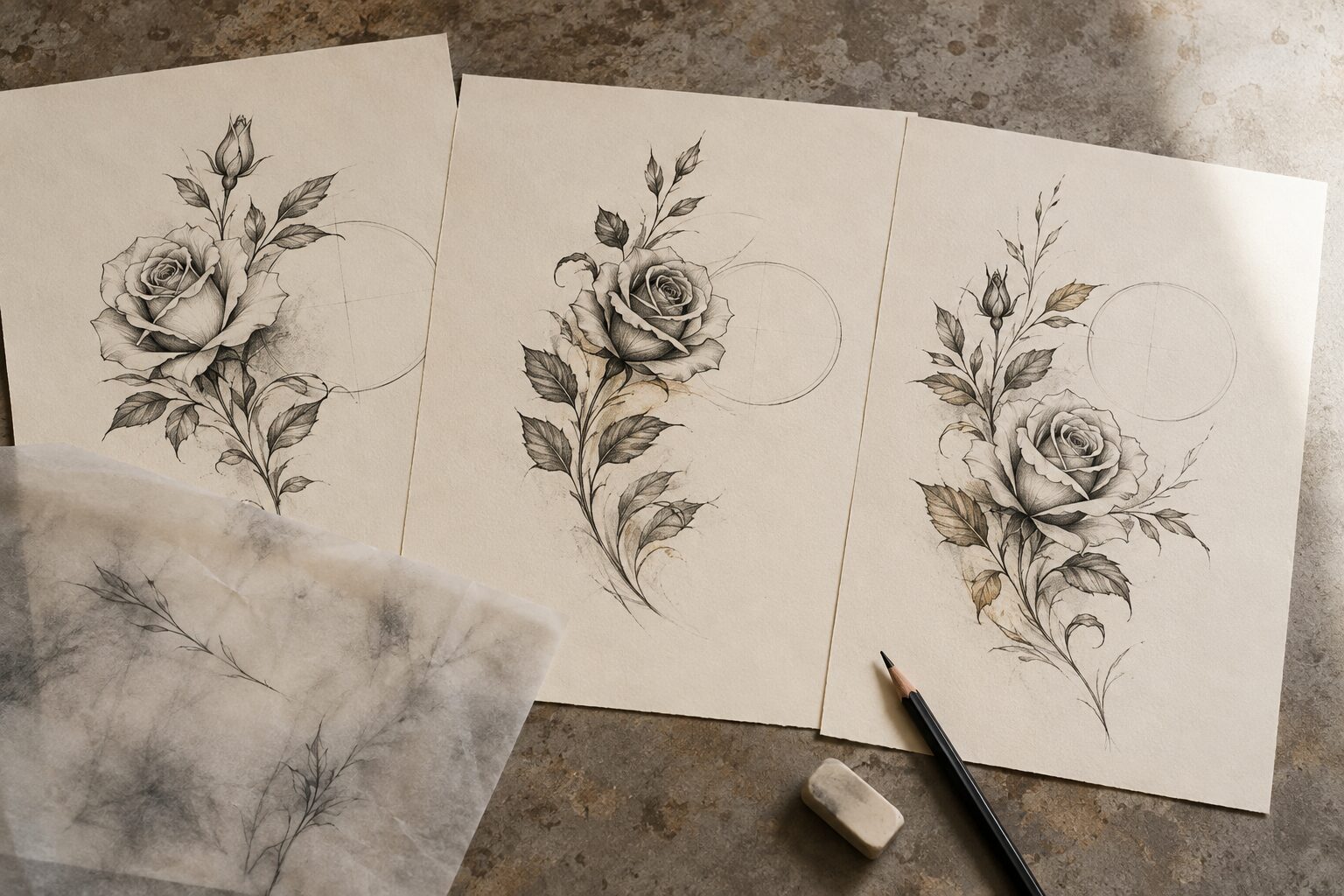
Suppose a trainer says that the main flower in a tattoo sketch is hard to distinguish from surrounding leaves. That comment can become a small, testable design task.
- Keep the main outline and make three paper variations of the surrounding spacing.
- Compare all three at the same size.
- Ask which version makes the intended focal point clearest and why.
Record the explanation, not just the chosen version. It will help you recognise the same issue in a different design.