How to Learn Fine-Line Tattooing: A South African Practice Guide
Want to add delicate lettering, small botanical designs or clean minimalist outlines to your tattoo skills? Fine-line tattooing is now included in Skinart’s tattoo course. This guide turns that goal into a practical learning sequence, from a readable drawing to an instructor-reviewed practice piece. South African learners can compare online study with in-person training; the technique still needs deliberate practice whichever format you choose.
Start with a drawing that works at its intended size
Fine line describes the visual character of the work: slender lines and carefully controlled detail. It does not mean that every design should be tiny. Sketch a simple leaf or geometric outline, print it at the size you intend and look at the empty spaces between marks. If the drawing relies on enlarging a photograph to make sense, simplify it before turning it into a practice task.
Make three versions: the original, one with fewer details and one slightly larger. Ask your tutor which version makes the clearest learning exercise. Keep the rejected designs too; they show the decisions behind the final choice.
Build line control before adding decoration
On paper, practise straight segments, open curves, closed shapes and deliberate endpoints. Keep the reference beside each attempt so you can compare the intended path with what you drew. Work on one issue at a time: continuity, changes in width or the way two lines meet.
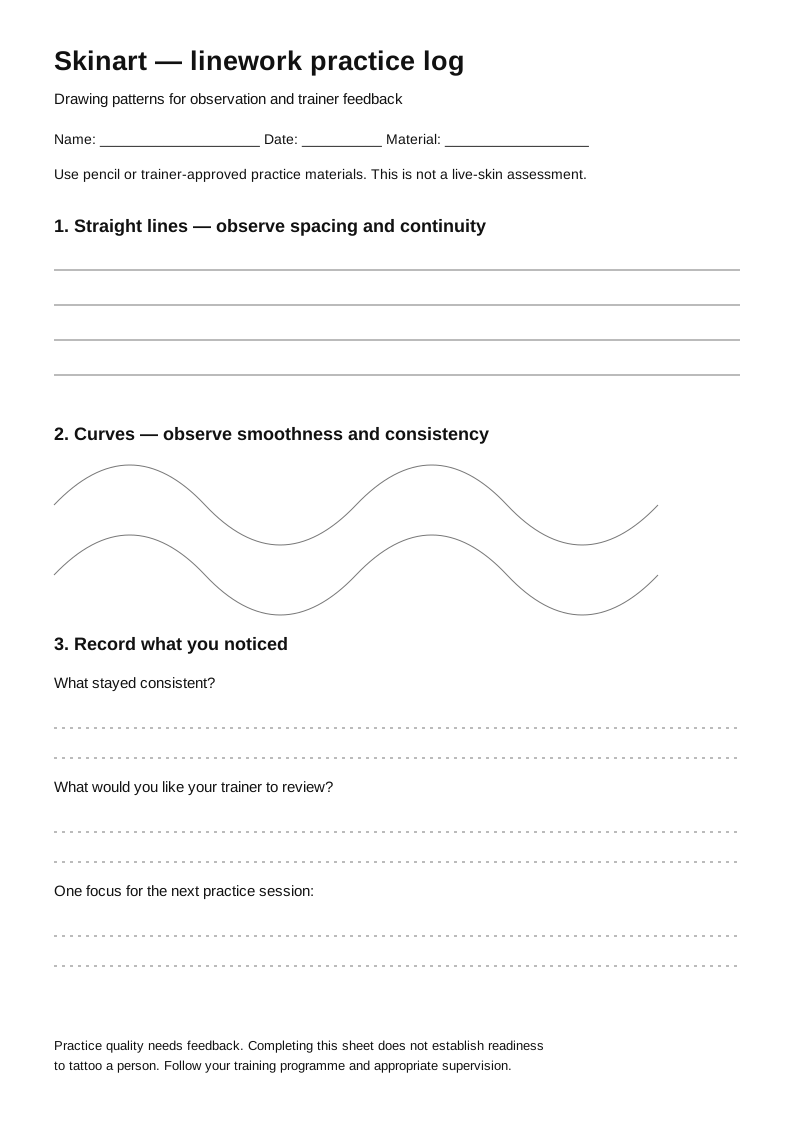
Start with Skinart’s free A4 line-control practice sheet for three pen or pencil exercises: lines between endpoints, curves and repeated circles. Choose one task and keep a note of what you want to improve. Use the printable linework practice sheet to date your attempts. A neat drawing is useful preparation; it does not by itself demonstrate readiness to tattoo a client.
Move the exercise into the course practice sequence
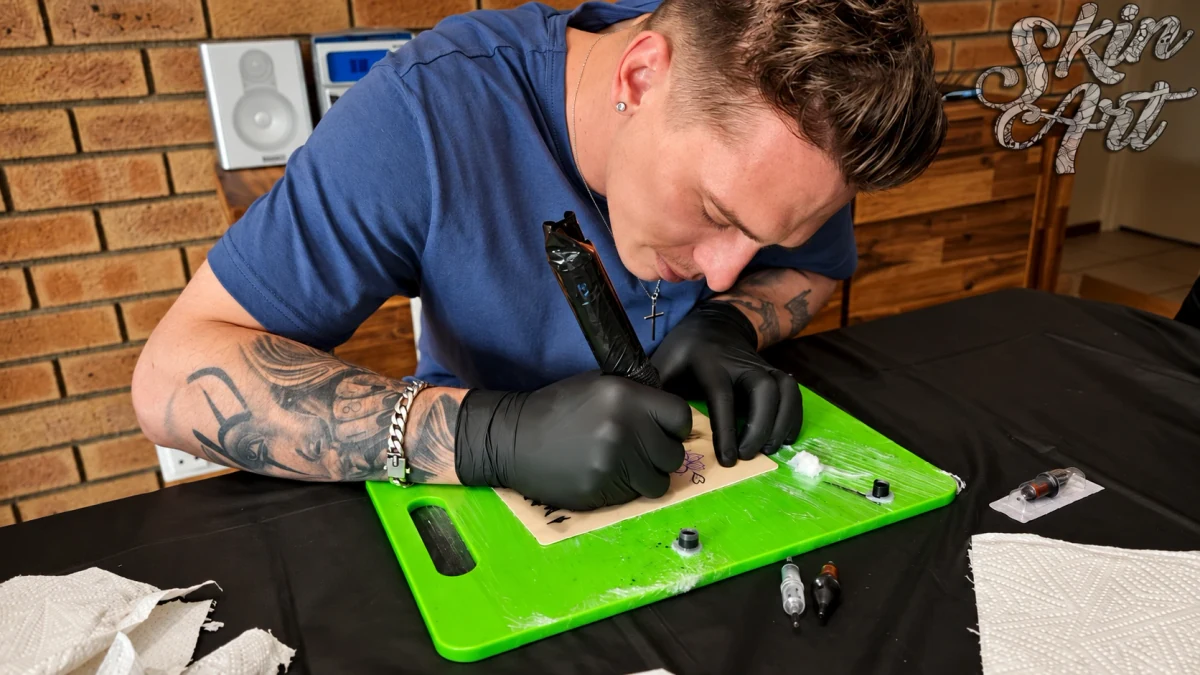
Once your instructor has approved the task, follow the fine-line lesson and assigned practice on the specified practice material. Use the preparation, handling and disposal procedures taught in the course. Record the design, material and equipment configuration so your tutor can interpret the result.
Fine-line control is not a universal voltage or a fixed depth copied from a social video. Ask for guidance for your actual equipment. If a practice result is inconsistent, keep it for review rather than repeatedly tracing over it to make the photograph look finished.
Compare fine line with the other tattoo styles taught
The tattoo course also covers blackwork, tribal and Māori-inspired design exercises, traditional tattooing, watercolour and colour realism. Compare how each assignment uses outlines, contrast and colour. Fine line adds another approach to the same foundation of design, linework, shading, hygiene and professional practice.
Choose a simple fine-line design to sit beside a traditional or blackwork practice piece in your learning record. Label the material and purpose honestly. Cultural designs require informed, respectful context; a design exercise is not a claim of qualification in a cultural tradition.
Choose the training format and get a focused review
Review the South African online tattoo course or in-person tattoo training. Fine line is an inclusion in the tattoo course, rather than a separate checkout purchase. Check your selected option for equipment and practical arrangements.
Submit the unedited reference, the complete attempt and one close-up. Ask a specific question such as “How can I make the joins in this outline more consistent?” Use that answer to set the next exercise. A certificate and a clean practice photograph do not replace the requirements for safe client work.
For South African workplace questions, contact your municipality’s environmental health office. For a Durban example, eThekwini’s community health page lists its environmental health services. Confirm the current requirements for your intended services and premises before working on clients. For general information on caring for tattooed skin, the American Academy of Dermatology explains that UV light can fade some inks. No design or style guarantees an unchanged healed result.